About Me

I am a student at GCE Lab School in Chicago. This is my blog to show all my work.

Pages

Friday, April 26, 2019

Is Health Insurance for Everyone?

This is the first unit of the final Junior humanities class Policy. In the first unit "Legislative," we learned all about the legislative branch of the government. We asked ourselves what policy really means, and what the difference between a policy and a law. We also looked at different policies made by the government or others. We looked at how a bill becomes a law, and how the different branches can check each other. We also learned about war and how war is declared. We had a debate in class about whether the U.S. should have joined WWI. We looked at the declaration of war and researched how the war affected the economy. For our FE we went to the Chicago City Council and met with officials and discussed issues around the city. We also met with Alderman Elect Andre Vasquez in his office in Andersonville. We discussed how city officials create and vote on policy. For this project, we had to write a letter to our representative. This could be an alderman, a state representative, or a house representative. I chose my district representative Danny K Davis who represents the 7th ward in the Chicago area. I do not live in Chicago so I don't have an alderman. We had to write about a current bill being proposed, and we had to encourage them to vote on it or not. I wrote to Representative Davis about health insurance for all. I chose this because I want to go into the medical field and I don't want to see people denied care because of their financial status.

Danny K. Davis
Congressman for the 7th District of Illinois
2815 West 5th Avenue
Chicago Illinois 60612

Dear Rep. Davis,

    Did you know that 27 million people in the United States do not have health insurance? Another 38 million do not have adequate healthcare. I believe that all Americans have the right to health insurance. Health care is a basic need that everyone deserves no matter their income. The Health Care For All of 2019 act would ensure that every United States citizen would get health care coverage. I would like to tell you why I think you should vote on this bill.

    Many people who do not have medical insurance delay or do not undergo necessary medical procedures out of need. This causes unnecessary health complications not due to lack of medical care, but because of lack of money. The number of uninsured people has fluctuated over the years. In 2008, when the financial crisis hit, over 44 million or 17.1% of the population were uninsured. In 2016, the number of uninsured people decreased from 44 million to around 27 million or 10% of the population was uninsured. Many people remain uninsured because of high costs and coverage not being available through jobs. The people who remain uninsured are most commonly low-income families, especially of color. According to the Henry J Kaiser Family Foundation: “One in five uninsured adults in 2017 went without needed medical care due to cost. Studies repeatedly demonstrate that the uninsured are less likely than those with insurance to receive preventive care and services for major health conditions and chronic diseases.” Another key fact is that undocumented immigrants are not eligible for Medicare.

    I would like to go into the medical field, and I do not believe in turning patients away or having patients not come because of financial reasons. If people come in for treatment, no matter if it is serious or not, they should be able to be treated with the same care anyone with any income should be. If people are not coming to be treated, underlying more serious issues may not be diagnosed until it is too late. A person who has regular check-ups and seeks medical attention when they feel is needed are far more likely to have a serious condition diagnosed early, and treated properly. According to the Henry Kaiser Family Foundation: People without insurance coverage have worse access to care than people who are insured. “One in five uninsured adults in 2017 went without needed medical care due to cost. Studies repeatedly demonstrate that the uninsured are less likely than those with insurance to receive preventive care and services for major health conditions and chronic diseases.” As a person who is passionate about medicine, and believes that everyone has the right to be treated equally, I think this is an extremely important issue that needs to be addressed. The issue could be addressed by the signing of the Healthcare For All Act of 2019

    Imagine a woman not being able to get regular Pap smears to screen for cancer, or a child no being able to get vaccinated for preventable illnesses. These are the kinds of issues uninsured Americans are facing right now. Medications, check-ups, procedures, surgeries, tests are covered by Medicare. Families who do not have access to Medicare have to pay out of pocket for these expensive necessary treatments which can range from a few dollars to hundreds of thousands of dollars. A patient with diabetes should not have to pay out of pocket for a life-saving drug like insulin. According to The Hill. over 7 million Americans rely on insulin. According to the American Diabetes Association, the average price of insulin nearly tripled between 2002 and 2013. Insulin is a life-saving drug and it is unfathomable that low-income people have to pay prices decided by for-profit companies.

    The signing and progression of the Health Care For All Act of 2019 would ensure that all Americans would have health insurance. This act would eliminate private insurance companies and would give hospitals and other health care centers an annual budget. This means that people of all incomes could get the medication, procedures, tests, checkups, and surgeries they need. This would greatly reduce the number of fatalities related to unknown and undiagnosed medical conditions. According to Modern Healthcare, “Rep. Pramila Jayapal (D- Wash.) told reporters that the goal of the Medicare for All Act of 2019, which has more than 100 co-sponsors, is to completely overhaul the U.S. healthcare system and convert it to a government-run entity.”

     There are some downsides to the bill. According to Modern Healthcare: Jayapal expects that around one to two million people would be out of work if the legislation becomes law because of the elimination of most private insurance. She said that 1% of the global budget for hospitals will go to a fund to provide services to displaced workers in the insurance industry. "This could include pension benefits, include any number of things that would take care of these workers as we transition," Jayapal said. "I do think there will be a boon to the economy once we get healthcare under control,"Jayapal added that a private insurance industry could still exist, but they couldn't cover the same benefits as Medicare, which include coverage of prescription drugs, hospital and physician services and long-term care services. However, insurers could cover services such as cosmetic surgery or other types of elective benefits.” Even though there would be an adjustment period for the healthcare system and the economy, the long term outcome would greatly benefit generations to come. With the health care for all act, we could make the lives of so many Americans better.

    In the Declaration of Independence described Americans unalienable rights. These are Life, Liberty, and the Pursuit of Happiness. With millions of Americans without insurance and without live-saving medications and procedures, these unalienable rights are not being met. A person who is constantly sick is not happy, a person who dies because of their lack of income is being denied life. So I urge you, please help make America a better place by voting yes on the Health Care for All Act of 2019.

Sincerely,
-CM

U.S. House of Representatives. "Danny Davis" (2014) Wikimedia Commons.

In conclusion, this was an interesting project. It was hard to find a bill that was still current and that I want to write about. I think choosing a very talked about bill was a good idea because there are a lot of opinions and information about the bill. I am proud of the research I did. I think I found some meaningful statistics and facts that can grab attention. I hope you like my project!

Works Cited:

"Healthcare Crisis: Who's At Risk?" PBS.org. Public Broadcasting Service. Web. 24, April 2019.

"Key Facts About The Uninsured Population." KFF.org Henry J. Kaiser Family Foundation. Dec 07, 2018. Web. 24, April 2019.

King, Robert. "House Democrats Introduce 'Medicare for All' bill." Modern Healthcare. Crain Communications. Web.  Feb 27, 2019.

Pramila Jayapal "HR 1384: Medicare For All Act of 2019." Govtrack.us. Feb 27, 2019. Web. 24, April 2019.

"Sky Rocketing Insulin Prices Provoke New Outrage." HeHill.com. Web. 24, April 2019.

Wednesday, April 24, 2019

Truss The Bridge

This is the first unit of the final Junior STEAM course: Urban Planning. In this unit called "Load", we learned about forces and load. We looked at aspects of urban planning, specifically bridges. We looked at different types of bridges and how they handle the forces put on them. Along with this, we learned about Newton's three laws of motion. We also looked at free body diagrams, which show the forces acting on an object. We also learned about equations of motion and various ways to calculate angles and sides of triangles like the Law of Sines and Cosines and Heron's formula. For an FE, we went to downtown Chicago and met with Shehara and Gabriel from Metropolitan Planning Council. We walked along the river and looked at the various bridges. We also went to Millenium Park and learned about how the city turned Millenium Park from a train yard, to a spot millions of tourists visit each year. That's what urban planning is all about. For this action project, we teamed up with our classmates to make a bridge out of nothing but popsicle sticks and Elmer's glue. We had to make a truss bridge that could hold at least 10 pounds without breaking. We had to build, analyze, and draw our bridges. You can view my partners OL and MW blogs by clicking on their initials!


You can watch us test our bridge here!


In conclusion, this was a very interesting project. I never am very fond of partner work, but I was able to work with my partners to somewhat equally spit up the work. The hardest part of this project was actually building the bridge. The glue took a long time to dry, and it was very hard to keep pieces in place. I am most proud of all the calculations my group and I did. It was fun to analyze what we actually built. I hope you enjoyed my project.

Monday, March 25, 2019

ER Thoracotomy: Is it Worth the Risk?

This term, I proposed my own independent study. We were offered the opportunity to work independently and create something of our own. I proposed a surgical science study. I spent these 9 weeks researching and learning about different procedures. I kept track in with entries in a Google Doc I made. I first researched anatomy. I looked at the anatomical landmarks of the thorax and the planes of the body. I allowed myself to drift between what kind of surgeries I wanted to study. I started out with cardiothoracic surgery. I found myself drifting toward more minor, emergent procedures. I am fascinated with emergency medicine/surgery, so I wanted to really understand the basic emergency surgical procedures. I looked at procedures like chest tubes, thoracotomy, needle aspirations of pneumothorax, and pericardiocentesis. I then found myself drifting into neurosurgery. Both cardio and neuro are at my top interest. I looked into some common neurosurgical procedures such as craniotomies and craniectomies, hemispherectomy, corpus callosotomy, lobectomy, ventriculostomy, and ventricular peritoneal shunt. I also looked at some emergency neurosurgical procedures like emergency ventriculostomy, Intracranial probe insertion. I also looked at some emergent airway procedures like cricothyroidotomy and tracheotomy. For my FE, I visited the American Hematological Society's annual hematological cancer conference ASH. My friend and classmate NB also came with me, as she is studying medicine as well. It was very technical, and I am rather ignorant when it comes to the more diagnostic side of medicine, so it was interesting to learn about. For my project, I wanted to something more than just research. I have always been interested in emergency thoracotomy, and I have heard several different sides of to argument as to whether it is safe or not. I wanted to research thoracotomies, and find some statistics, and then ask people what they thought. I hope you enjoy!

You can view my research from my independent study here.


Here is a video of me performing a Clamshell Thoracotomy.


In conclusion, this was my dream class. I am always trying to connect what I am learning about medicine because it is my passion. I wanted to flaunt my surgical knowledge, and I found some statistics, but I mostly knew all of this information already. I really was able to do what was interesting me a the moment. I wished I could have challenged myself more. Sadly, I don't really know anyone that knows more than I already do at school. I often have to challenge myself. I wish I could have talked more with my teacher, but overall, I am very happy with the work that I have done.

Works Cited:

Fallon, Brian. "Atlas of Trauma Clamshell Thoracotomy." TRAUMA.org. April 2005. Web. Feb, 5 2019.

Guthrie, Kane. "ED Thoracotomy: Is it Just The First Part of the Autopsy?" Life in the Fast Lane.com. June 2, 2018. Web. Feb, 8, 2019.

Lent S, Gretchen M.D. "Emergency Beside Thoracotomy." Medscape.com. August 7, 2017. Web. Feb, 14, 2019.

Thursday, March 21, 2019

The Essential-Clock!

This is the 3rd and final unit of the Junior STEAM course Light, Sound, and Time. In the 3rd unit, we studied time. We wrapped up the mini-lessons. These were a series of lessons that each student gave about a chapter of a book they read in each unit. I this unit we discovered latitude and longitude, and how to calculate your location without a clock using Greenwich Mean Time (GMT). We learned about the Prime Meridan as well as the International Dateline and all about timezones. We also learned about pendulums and how they can be used to tell time. We mainly focused on the Foucault Pendulum, which is a pendulum that used the earth's rotation to tell time. We also looked at the different ancient time telling devices like sundials. We also studied the universe and dark matter and wormholes. We also learned some math concepts like calculation arc length and angle in a circle, as well as calculating vertexes. We visited the Adler Planetarium where we learned about the universe. We looked at different planets calculations, and we saw how time has affected culture and we looked at other historical devices. For this action project, we had to come up with our own time telling device. It could be inspired by an old way of telling time, but we had to make it better We then had to make a video advertising the product.

You can view the script of my video here


In conclusion, this was a pretty difficult project. I really struggled coming up with something that wasn't already come up with. Making the video was also pretty difficult. I kept messing up on the voice over and having to restart. I am proud of how my video came out as it is clear and well put together. I really enjoyed this class and I am happy with how I did. I learned a lot in this class about how we perceive the world, and I definitely see the world different now.

Works Cited:

Bendini A. Silvio. "Measurement with Insense in Japan." Japanese Insence.com. Cambridge Press. 2002. Web. 21, March 2019.

Creating A People's Assembly

This is the 3rd and final unit of the Junior Humanities course "A Nation's Argument." In this unit, 1960's, we learned about the events of the 1960s and the Civil Rights era. We studied the Bill of Rights and the amendments that give Americans rights, and how they apply to people. We also learned about the lynching era where African Americans were hanged for committing minor offenses We also attended a Yale University Open Courses online lecture about the Civil Rights Era as well as the Selma march and the Watts riots in Los Angeles. The main focus of this unit was to create our own people's assembly. We wanted to discuss policing in Chicago. We were able to create a format and roles for each other to create this assembly.  We brought in 4 guests that were able to talk to us about policing. We had one Chicago Police Officer, 2 community activists, and one researcher from NYU. We sat down with our guests and had a conversation about communities in Chicago and how they react to police presence. We also discussed policing in schools, immigration, and police officer suicide. For my project, I chose the issue of police suicide. It was very cool to hear first hand from an officer about why some police get depressed and how it is more than just trauma, but a combination of things. For this project, I created a thesis, antithesis, and synthesis about police suicide. I also did research and found statistics to re-enforce my argument.


In conclusion, this was a very interesting project and class. I am happy with how I performed in this class, even if I always wasn't 100% about what I was doing. I thought this last project was a neat way to tie in our communal project that was the policing assembly. I liked how each student got to pick the issue they wanted to address. I am proud of the research that I did, and I am proud that as a Junior cohort, we were able to come together and have a real-world discussion with real-world people.

Tuesday, March 12, 2019

What Does It Take To Become a Citizen?

This is the 2nd unit in the Junior Humanities class "A Nation's Argument." This unit is called "1850's. In this unit, we learned about the historical events of the 1850's. We studied the events that lead up to the civil war, as well as the political climate of America at that time. We studied events such as the Kansas Nebraska Act. We learned how America was split on whether slavery should be legal or not. To learn more about American history, we once again participated in Yale University's open courses. We attended a lecture by Professor Blight about the founding of the Republican party. We also learned about immigration. We learned about what it takes to become a citizen, and we tried to take the naturalization test that immigrants have to take. We also visited the Immigration court where we saw live immigration hearings. For this AP, we had to amend the naturalization test. This was up to interpretation. I decided to make it more personable and related to what America means to you. Enjoy!

Image result for immigration and naturalization service
United States Government. "Seal of the U.S, Immigration and Naturalization Services." (2000)
Do you know what it takes to become a citizen of The United States? In fact, it is a long and treacherous process, in which one step is t take a “naturalization test.” This is a part of the citizenship process where an applicant takes a 100 question test on all things America. Questions range from government to geography and history. A U.S. Citizenship and Immigration Service officer will ask 10 questions, and 6 out of 10 questions must be answered correctly. A form of naturalization tests have been around since the early 19th century. According to the USCIS website, trick questions were eliminated in the 1930s to “ensure that questioning would establish the applicant’s attachment to the principles of the Constitution rather than the mere ability to memorize facts.”

I think that this quote is an interesting statement, as a lot of people today say that the test is still just a memorization test, even though the purpose is to understand the government, history, and geography of America.

I believe that the citizenship exam should be more than memorization. People who are coming to America are usually looking for a better life than they could have in their native country. I believe questions on the test like:

88. Name one of the two longest rivers in the United States.
92. Name one state that borders Canada.
95. Where is the Statue of Liberty?


Are very general, easily googled, and generally useless questions. These questions are also probably not known by many American born citizens. To me, these questions feel more like trivia questions, rather than questions that all Americans should know. These questions are all connected and are pretty general geography questions. I think it is good to be a well-informed citizen, and I think most or all Americans should know these answers, but I don’t think it is nessacery for a brand new citizen or a non-native person who is coming to America for the first time to know. Imagine going to a brand new country and having to know the geography (even if it is pretty well known.)

A syllogism for the current test would be: American citizens know basic geography, therefore all new citizens should know basic geography. This is a very generalized test. I believe that because some Americans know the answer to these questions, It is assumed that every American and new citizen should know these answers. I think that it is fairly hypocritical since many American citizens do not know the answer to these questions.

I believe that the citizenship test should be revised into a project that an applicant does on what America means to them. For this, there is no right or wrong answer, (which could present problems) but it is the opinion of the applicant. This project could be much more worthwhile than memorizing facts. It could also show the USCIS agents why this person is coming to America, and what they plan on doing once becoming a citizen.

In Article 1 Section 8 of the U.S. Constitution, the following is stated: “To establish an uniform Rule of Naturalization,” This means the Congress is granted the right to establish a rule of naturalization. This determines how immigrants may or may not become citizens, even back in the 1700s. At this time there was no naturalization test, but it was up to the government to determine if someone could become a citizen even if they do not meet the criteria of: “No Person except a natural born Citizen, or a Citizen of the United States, at the time of the Adoption of this Constitution, shall be eligible to the Office of President.” In Article II Section I. Even to this day we still have the government determine who can become a citizen, but it seems we haven’t come much farther than we have when the country was first born. With my new way of naturalizing immigrants, we can move forward in the ways we accept people into this country.

I declare that the U.S. Citizenship Naturalization test shall be amended into a self-fulfilling project about what America means to them. This will be an open format project will no restrictions. This is purely to show the government what America means to this applicant, and what their plan is. This will eliminate memorization, and trick questions to give everyone a fair chance.

My classmate KS had this to say about my amended test: “I think this is a fairer way to judge who gets to come into America. It is less general and more personalized.”

This amendment is signed by:

CM & KS


Works Cited:

“Origin of the Naturalization and Civics Test.” USCIS.gov. Department of Homeland Security. 15, Jan 2013. Web. 9, Mar 2019.

“The U.S. Constitution and Immigration.” Boundless.com. Boundless Immigration Inc. 3, Jun 2017. Web 12, Mar 2019.

U.S. Constitution. Art.I, Sec 8. Art. II Sec. 1.

In conclusion, I did like this project. I thought it was a fun but challenging way to think about how we as Americans see immigration. I always thought the test was suspicious, but I really do feel like my plan could work. The most challenging part was connecting my amendment to a historical document. I was able to find some good connections, but it was challenging. I am really happy with how this turned out.

Sunday, March 10, 2019

DIY Guitar

This is the 2nd unit in the Junior STEAM class, Light, Sound, and Time. The second unit was focused on sound. We learned all about sound and how it can be applied to the real world. We studied how light and sound are related, and how to calculate the distance it takes sound to travel. We learned about things like the Doppler effect and sonic booms, where sounds that are moving have a different pitch, or what happens when something travels faster than sound. We also studied how our ears perceive sound and the human threshold of hearing. We looked at the anatomy of the human ear and studied sound waves and measured them. To prepare for our action project, we went to the Chicago Music Exchange to learn about guitars and other instruments and how they produce sound. We were able to play instruments, and talk to experts about how the different instruments produce sound. For the action project, we made our own guitars or Diddley Bows. This is a one-stringed guitar made out of different household materials. The made the Diddley Bow, and then recorded ourselves playing it, and we drew the harmonics the played. We also calculated the length and angle of the guitar and the volume of the resonator.

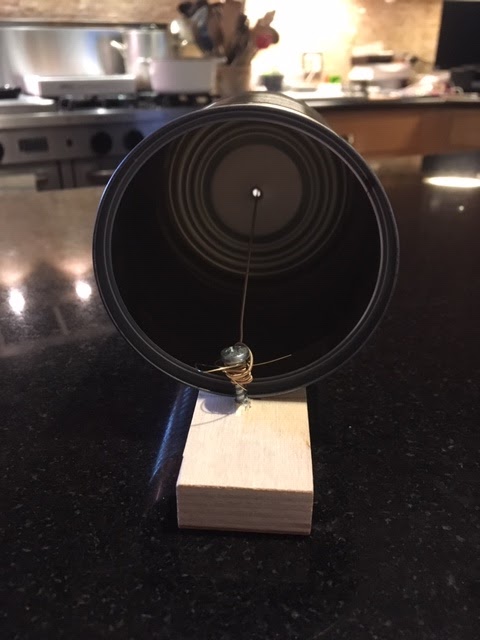
CM "Diddley Bow" (2019)
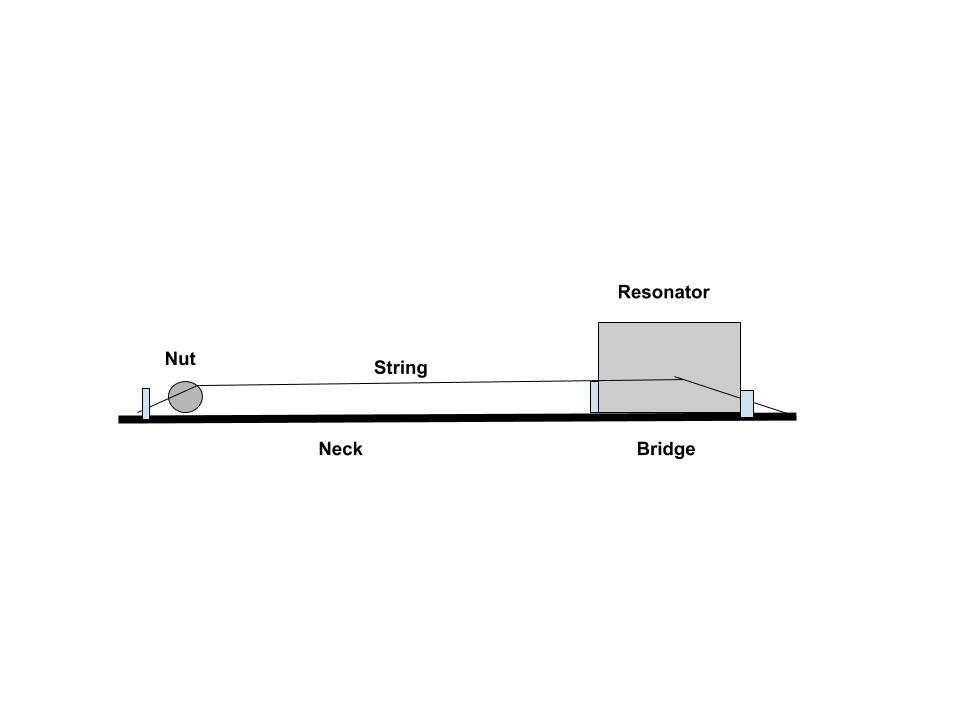
The instrument I made is called a Diddley Bow. It is a type of homemade guitar. It is made out of wood, a tin can, batteries, and guitar strings. The diddley bow can be as little as 1 string, or as many as 6. Diddley bows also have varying amounts of detail and features. My Diddley bow was made by using a 2 x 4 piece of wood and measured where I wanted the nut to go. The nut was made by using a dead AA battery. I then used a tin can as the body or the resonator of the Diddley Bow. I poked a hole in it, and then threaded the guitar string from the nut through the resonator and then tied it around the screw at the base of the resonator. I made sure that the string was taught enough to make loud enough sound but that it wasn’t too taught to play.


The Diddley Bow produces sound by vibrating the string. The string’s vibrations are amplified by the resonator or the body which is made out of a tin can. The pitch can be changed by tightening or loosening the screw that the string is attached to, like a tuning peg. Or shortening the length of the string. The volume can be changed by how hard the string is plucked. This changed the amplitude of the wave that the string makes, producing a louder sound. The width of my string is 0.05 in.
CM "Diagram" (2019)


My Diddley Bow demonstrates wavelength and frequency by manipulating the strings. When the strings are plucked, a standing wave is produced. This is how sound is portrayed in waveform. The longer the wavelength, the lower the frequency and vice versa. Pitch is how our ears perceive frequency, the higher the frequency of a wave, the higher pitch it will sound. If the string is plucked and produces a high-frequency wave, a higher pitch sound will be created. If the wave has a lower frequency, it will produce a lower pitch sound. This is how the Diddley bow is played so it can produce different pitches.

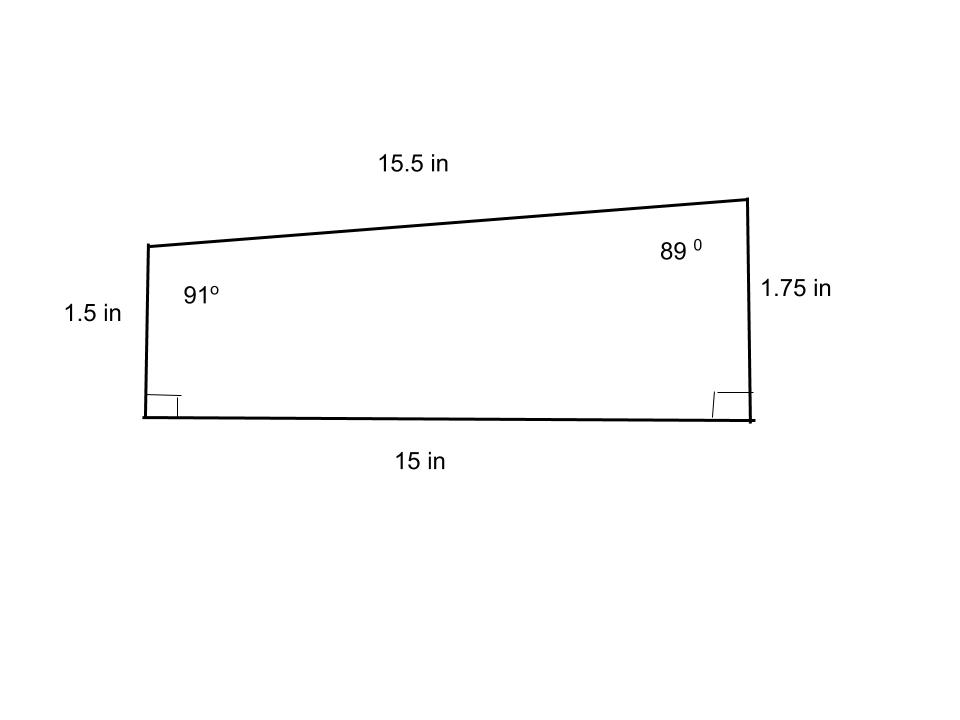
Here is a recording of me playing the Diddley Bow The side view of the guitar created a trapezoid with an area 15 x (1.5 + 1.75) / 2 = 1.625 x 15 = 24.375 sq in. I figured out how to find the angles by dividing the trapezoid into a rectangle with a triangle on top, with a base of 15 and a height of .25 and a hypotenuse of 15.5. To find the upper right angle, I calculate tan -1 (15 / .25) = 89 degrees. The left angle of the triangle is 1 degree because 89 + 90 = 179 which is 1 short of 180 degrees. This means the left angle of the trapezoid is 91 degrees because 1 + 90 = 91.

    CM "Trapezoid" (2019)

The tin can I used as a resonator has a radius of 1.75 in. To calculate volume, we need to know the area of the circle and the height. The area of my circle is π 1.75 ^2 = 9.62 cubic in. The height is 4.5 in so the volume is 4.5 x 9.62 = 43.29 cubic in

CM "Resonator" (2019)

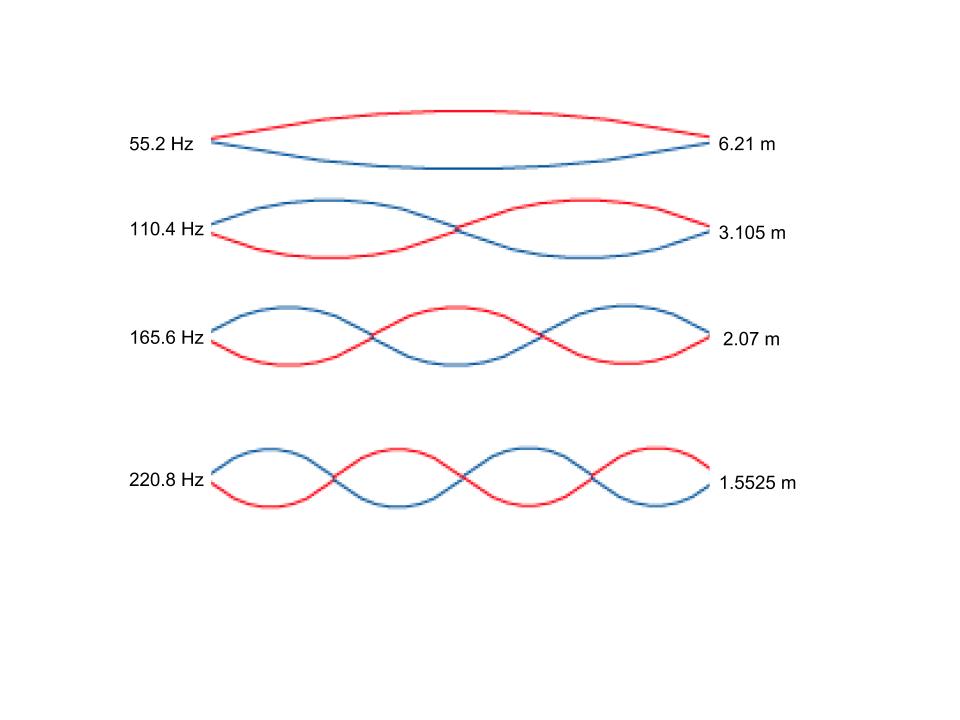
My Diddley Bow plays 4 harmonics. I found the frequency of my Diddley Bow which was 55.2 Hz (Hertz) I then found the wavelength. The speed of sound is 343 m/s so 55.2 Hz / 343 m/s = 6.21 meters which is my wavelength. As Frequency gets larger, the wavelength gets smaller.

The 1st harmonic represents the open note.

The 2nd harmonic represents the ½

The 3rd harmonic represents the ⅓ and ⅔

The 4th harmonic represents the ¼ and ¾


Frequency = 55.2 Hz Wavelenth = 6.21 meters

Frequency x 2 = 110.4 Hz Wavelength / 2 = 3.105 meters

Frequency x 3 = 165.6 Hz Wavelength / 3 = 2.07 meters

Frequency x 4 = 220.8 Hz Wavelength / 4 = 1.5525 meters

CM "Harmonics" (2019)

In conclusion, I liked this project. I thought it was an interesting hands-on way to learn about sound and sound waves. I enjoyed making the Diddley Bow as well as calculating it. This was a challenging project as I had a lot of other things going on, but I am proud of how the Diddley Bow actually came in the end.


Marine Biodiversity Literature Review

It's officially my last action project at GCE! I've done over 80 action projects and here is my last. This project is for my last Se...