About Me

I am a student at GCE Lab School in Chicago. This is my blog to show all my work.

Pages

Showing posts with label STEAM. Show all posts

Monday, June 8, 2020

Marine Biodiversity Literature Review

It's officially my last action project at GCE! I've done over 80 action projects and here is my last. This project is for my last Senior STEAM course Frontiers. We only had 1 unit for this class. This whole class was about the frontiers of human exploration. We were originally going to look at ocean exploration, space exploration, and computers and AI. We only got to look at ocean exploration. We spent this entire term learning about the ocean and exploration. We looked at everything from early human explorers, to ocean geography to marine life. I really enjoyed learning about the ocean. I have always had an interest in marine biology. For FE's this term, we had 2 virtual guests. We had some speakers talk to us about their plan to create a nature sanctuary along the Chicago River. We also learned from a marine biologist who helped write this course. I enjoyed both of these guests and I think they both related to the class very well. For our action project, we had to write a literature review on one of the 8 marine ecosystem challenges. I chose the 1st challenge which is how climate change affects biodiversity. I have never written a literature review before so there was a bit of a learning curve but I am happy with how this turned out.


CM

6/3/2020

Frontiers

Aaron Moring D'angier 

One of the eight Grand Challenges in Marine Ecosystem Ecology is Anticipating the effect of climate change on biodiversity. This is key to understanding how to help preserve fragile marine ecosystems. Climate change is affecting the ocean in many ways including temperature change, current change, and acidification. All of these changes can be detrimental to marine life living in the areas affected by climate change. Studies have shown that the areas of most concerns in regards to climate change are some of the richest areas of biodiversity in the oceans. Also, Temperature affects marine life which will cause mass migrations before mass extinction happens. These studies show that even currently, climate change is already making a big impact on marine ecosystems today. By researching how climate change is affecting biodiversity currently, scientists can more accurately predict how global climate change will shape the future of marine biodiversity.

Climate change affects biodiversity. While the oceans continue to get warmer, the marine life that depends on the ocean to live are having to make adjustments. According to Beaugrand, “Climate change will permanently affect species loss in certain areas” (2015). In certain areas of the ocean, species loss could and will be detrimental to the entire ecosystem. If one species dies off or is no longer as populous as they once were, this can offset the entire marine ecosystem in that area. Certain species that rely on the extinct species for food will also be impacted. According to Hillebrand, “Local marine biodiversity shows what can happen in a broader community with changes in biodiversity” (2017). By studying one specific area closely, scientists can make an estimate on how climate change and other factors will affect biodiversity on a much larger level globally. “Anticipating the effect of climate change on biodiversity is crucial for adaptive management of ecosystems.” (Molinos et al, 2016). By anticipating the effects of climate change, a plan of action can be set in place to be better prepared to manage fragile ecosystems.

Warming of the planet will affect species globally. According to Beaugrand, “Minor warming is expected to have a minor influence on biodiversity. Moderate warming is the biggest concern.” (2015) While minor changes in temperature will go mostly unnoticed, sudden more extreme rates of temperature change could be detrimental to marine life globally. “More extreme warming at the poles means a probable mass migration of marine life.” (Hillebrand et al, 2016) With colder temperatures at the poles year-round, climate change has the most profound impact on these regions. With polar ice melt, not only marine life is suffering but also the animals who live on the ice. Hillebrand expects to see a mass migration of species from the poles in search of colder waters. With all of the oceans warming, he also expects to see species loss due to temperature. “These results strongly suggest that the millennial stability of current global marine diversity patterns, against which conservation plans are assessed, will change rapidly over the course of the century in response to ocean warming.” (Molinos et al, 2016) Plans have to adapt to the ever-changing climate change crisis in order to help marine life.

Marine animals are very sensitive to temperature change. Marine animals rely on consistency in their temperatures in order to live. With the changing temperatures, especially in the poles, it is becoming harder and harder for these animals to live where they do. According to Hillebrand, “These responses comprise adaptation and phenotypic plasticity as well as range shifts. The observed range shifts show more rapid shifts at the poleward range edge than at the equator-near edge, which probably reflects more rapid immigration than extinction in a warming world.” (2017). Animals will start to migrate from where they originally were to other areas of the ocean. Hillebrand thinks that this mass migration will happen before any mass extinction.

Comparing climate change throughout history will give a clearer view of biodiversity in the future. According to Descombes, “We found that under the RCP 8.5 climate change scenario, the global suitability for coral reefs may increase up to 16% by 2100, mostly due to improved suitability of higher latitudes. In contrast, in its current range, coral reef suitability may decrease up to 46% by 2100” (2015). By studying what is happening in marine biodiversity now, a more accurate idea of what the future of marine biodiversity can be created. “Sea surface temperatures during the Eocene epoch were warmer than forecasted changes for the coming century, and distributions of corals during the Eocene may help to inform models forecasting the future of coral reefs” (Descombes et al, 2015). Current models are showing the effect of climate change on marine life currently. By doing this research, the future is better understood. “Overall, these hot spots of marine biodiversity coincide with areas most severely affected by global warming. In particular, these marine biodiversity hot spots have undergone local to regional increasing water temperatures, slowing current circulation, and decreasing primary productivity” (Ramirez et al, 2015).

Biodiversity is essential for a healthy ecosystem. According to Beaugrand, “Our results indicate that local species loss will be a prominent phenomenon of climate warming in permanently stratified regions and that local species invasion will prevail in temperate and polar biomes under all climate change scenarios” (2015). These are examples of how biodiversity will be impacted by global climate change. According to Descombes, “Coral bleaching events threaten coral reef habitats globally and cause severe declines of local biodiversity and productivity. Related to high sea surface temperatures (SST), bleaching events are expected to increase as a consequence of future global warming.” (2015) With a lack of biodiversity, the ecosystems will suffer. “High extirpation rates are expected regionally (for example, Indo-Pacific), particularly under RCP8.5, leading to strong decreases in richness and the anticipated formation of no-analogue communities where invasions are common. The spatial congruence of these patterns with contemporary human impacts 7,8 highlights potential areas of future conservation concern. These results strongly suggest that the millennial stability of current global marine diversity patterns, against which conservation plans are assessed, will change rapidly over the course of the century in response to ocean warming.” (Molinos et al, 2016). Species invasion is a threat to marine ecosystems. With migration, more species will migrate and interact with other species. This could have a negative impact on marine life in the area. According to Ramirez, “Concerningly, some of the richest areas of biodiversity overlap with the locations most impacted by climate change.”(2017). Action needs to be taken soon in order to prevent catastrophic damage to marine ecosystems.

"Climate Effects On Marine Biodiversity." ECHO Action. (2017)
Works Cited:

Beaugrand, Gregory et al. “Future vulnerability of marine biodiversity compared with contemporary and past changes.” Nature.com. Springer Research. 1, June 2015. Web. 3, June 2020.

Descombes, Patrice et al.“Forecasted coral reef decline in marine biodiversity hotspots under climate change.” Wiley Online Library. Wiley & Sons. 21, January 2015. Web. 4, June 2020.

Hillebrand, Helmut et al. “Climate Change: Warming Impacts on Marine Biodiversity.” Springer Link. Springer Research. 16, August 2017. Web. 4, June 2020.

Molinos, Jose Garcia et al. “Climate velocity and the future global redistribution of marine biodiversity” Nature.com. Springer Research. 31, August 2015. Web. 3, June 2020.

Ramirez, Francisco et al. “Climate impacts on global hot spots of marine biodiversity.” Science Advances. American Association for the Advancement of Science. 22, February 2017. Web. 4, June 2020.
In conclusion, I am happy with how this project and class turned out. I enjoyed this class more than I have any class in a while. It's refreshing to learn about something that I am interested in. I found it a bit difficult to get started on this project, but once I got started it was pretty easy. I struggled with motivation to complete this project. Mostly because it's the very end of the term and I just wanted to be done. I'm proud of myself for completing my last action project at GCE. Now time for graduation!

Wednesday, March 18, 2020

Lakeshore Lacquers Business Plan: Behind The Scenes

Our winter term Final Presentation plans are a little different this time. Usually, we conduct Final Presentations at the school as an open house where guests come and see our work from the term. Due to this unprecedented situation with the Corona Virus, we had to conduct our Final Presentations virtually. This presented some challenges, but we were able to come together to make a final presentation virtually. The theme of this Final Presentation was guiding questions. We use guiding questions to drive the work in a certain unit or class. We had to pick a guiding question and present how we either answered it or what it means to us. I chose the question "how do you make a business plan?" This was the guiding question for the second action project for my STEAM class Social Entrepreneurship & You. I chose this question because this was the work I was most proud of and enjoyed doing the most over this term. I walked through how I created my idea, business plan, elevator pitch, and business pitch. Enjoy my Final Presentation. 
 

In conclusion, I enjoyed making this project. I did not enjoy the format of doing this from afar. I liked talking more about my project and getting to describe my process. I would have liked to present this project in real life, but this is the next best thing. I would have liked to work more independently, but we had to work together to keep a sense of community during this time. In the end, I am happy that I was able to continue my work on this action project. 

Friday, March 13, 2020

Lakeshore Lacquers Business Plan

This is the second unit of our Senior STEAM class Social Entrepreneurship and You. In this unit, we learned all about businesses. In the first unit, we examined ourselves and others' behavior. In this unit, we looked at how to actually run a business. We looked at different legal structures, mission and vision statements, demographics and physiographic, and marketing. We also looked at business concepts like the Triple Bottom Line and the Hedgehog Concept. We examined different companies and how they use these tools in their businesses. We had a couple guests come in and speak to us about starting their own businesses. We had one man come in and talk to us about his small construction and handyman business. We also listened to a man who started a non-for-profit called Greenwood to help underprivileged students get internships and jobs in finance. We were able to learn about how businesses work and how they got started. For this action project, we had to create our own business plans. This rubric was a bit different as we were able to choose how many points we want. We had to create a product that helped a social cause and create a business plan. I decided to create a nail polish brand and donate a portion of the proceeds to help the Great Lakes. Enjoy my project.

In conclusion, I really liked this project. I have always wanted to create and design a nail polish line. I love how this turned out. I feel confident about all of my decisions and my marketing. I also love the logo I made. I did this project in a very busy time and I think I managed my time well. Maybe one day I will actually create my own nail polish brand.

Saturday, February 1, 2020

How Can We Be More Prepared?

This is the first unit of the second senior STEAM course, Social Entrepreneurship. In this class, we have talked about how people's minds and personalities affect businesses. We covered some psychological topics and took multiple personality tests to see who we are as people. We looked at different types of relationships and business culture. We learned how to set SMART goals and use a SWOT chart to think about a situation. We also learned about Maslow's Hierarchy of Needs. We explored how that relates to personality and businesses. We did complex number review for the math portion of this unit. For this project, we had to look at a certain aspect of the school and analyze it. I chose college prep as it is something that I feel needs to be changed at GCE. I hope that my ideas and opinions are considered because even if I don't benefit from it, I want future GCE students to have a better time than I did.

At GCE, the goal is to place students in college. GCE has a college counselor that guides students through the college application process. While students' goals are different, the common goal of the school is to place students into college. Not every student goes to college, but 100% of students are accepted into college.

I am a senior. I have been at GCE since I was a freshman. Currently, I am committed to Northern Michigan University. As a part of the school, I have been guided through the college process. According to the Meyers-Briggs test, I am an ISTJ. Throughout the college prep process, I have had strengths and weaknesses. One of my strengths was my logical thoughts and analysis. This was an advantage for me because I was able to see what I was being taught and what I wasn’t. This allowed me to advocate for myself, and also reach out to cover things that were not being covered in class. According to the DISC personality test, I am the most dominant and the least compliant. This was one of my weaknesses because I would get frustrated if I thought I was not learning or being taught everything I could be.

In my opinion, I think the college prep at GCE is lacking. According to the GCE website: “At GCE Lab School, we provide personalized, one-on-one support and counseling to build your post-secondary plans. Our graduates have 100% college acceptance and 80% of our graduates receive merit-based financial aid.” I am genuinely concerned that students are not learning at grade level, and that there is not enough rigor in the curriculum. As far as specific college prep, I think it is even more lacking. There is no standardized test prep and the curriculum does not reinforce many of the concepts covered on standardized tests. The average ACT score of GCE shows. I asked some seniors what they thought about the college prep. “I don’t feel prepared at all,” said one senior. “Academically college will be a lot harder than GCE and I know that for a fact. There will be labs and I have never taken a lab class.” When I was talking to this senior about standardized test prep, I told her that the average ACT score of GCE is a 22. “I am not surprised,” she said. “There is no test prep and you are on your own. I think if the school wants to improve that score, they need to incorporate a lot more standardized testing which I know is not the focus at a progressive school like this. At the end of the day, yes standardized tests don’t determine how smart you are but it’s a part of the college process. I wish I had known this before.” I have also experienced a lack of support in actually applying and choosing schools. I did everything alone. From looking at schools to applying, to deciding. When I did choose a school, I felt completely unsupported. Other students have also had this experience. “I have not gotten much support in terms of where I choose to go.” said another senior. Multiple students have felt pressure and judgment about their choice. I believe that if the school wants to be selective about what schools students enroll in, the college prep has to improve dramatically. This way there will be more options for students, especially more selective options.

I do think there are positive aspects of college prep at GCE. I asked one STEAM teacher about college prep. “Our focus is on 21st-century skills. How to research and how to tell if something is a good resource. We have been looking at presentations and technological integration.” The GCE curriculum does make students think more broadly about why they are learning something. “The grade shouldn’t matter,” said another teacher. The goal of GCE teaching is to prepare students for college in a different way. This is why in some areas, GCE prepares kids for college very well.

The commons is a common resource that is shared among the people of the community. The commons in college prep at GCE is our college counselor. We only have one counselor, and she has to be responsible for the entire student body’s college journey. Some students require more attention than others or want more guidance. Other students may want to do the process more independently. This means that there are limited resources from the counselor, but there are other staff and faculty that can support students.

I analyzed college prep at GCE using a SWOT chart. This chart measures strengths, weaknesses, opportunities, and threats

CM SWOT Chart. (2020)
Maslow’s Hierarchy of Needs is a theory that tiers the 5 needs of a person. If one cannot be obtained, it is extremely difficult to achieve the one above it. I applied college prep at GCE to Maslow's Hierarchy. The bottom levels of Maslow’s hierarchy do not apply to college prep as nothing college prep related is a threat to your safety, nor will you die without them.  


CM "Maslow's Hierarchy" (2020)
I propose that GCE should institute mandatory test prep for all students. This would begin sophomore year, and continue throughout junior and part of senior year. This will bring up test scores overall and will allow students to apply and enroll in higher tiered schools. This will look very good for GCE and entice more students to enroll. The general content of the test prep classes also provides additional rigor and knowledge for students. There are no additional staff required and could be implemented as a period class, or a workshop.

I created a SMART goal for my proposal. SMART is an acronym for specific, measurable, achievable, relevant, and time-based.

CM "SMART Goal" (2020)
My role is limited in this goal. I will graduate in 4 months and won’t be able to take advantage of the test prep. I can be an advocate for this class and I can try to lobby for staff to make this happen next school year. My goal is for future students of GCE to have a better and less stressful college prep experience than I did. I also want GCE to succeed. I think in order for GCE to grow, many steps need to be taken, only one of which is college prep. I hope that GCE can make a comfortable yet challenging college prep experience for all students in the future.

Works Cited:

“AMD Interview.” CM. Chicago. January 30, 2020.

“Anonymous Interview.” CM. Chicago. January 30, 2020.

“Anonymous Interview.” CM. Chicago. January 30, 2020

“DISC Personality Test.” 123 Test.com. December 14, 2018. Web. January 10, 2020

“DS Interview.” CM. Chicago. January 30, 2020.

“Our Approach” GCE Lab School.org. Web. February 1, 2020.

“Your Test Results.” 16 Personalities.com NERIS Analytics Limited. Web. January 8, 2020.

Images:

“College-Ready, Community-Minded.” GCE Lab School. GCE Lab School.org Web. February 1, 2020.

“Portrait of a Graduate” GCE Lab School. GCE Lab School.org. Web. February 1, 2020.

In conclusion, I really enjoyed this project. I have a lot of strong feelings about GCE and I am happy I was able to make those feelings and ideas heard for an Action Project. I wish I had more time to do a bit more, but this is something I will be advocating for until I leave. I think GCE can do better and I would like to see that happen.

Saturday, November 16, 2019

How Much Does Health Cost?

This is the second and last unit in my senior STEAM course Economics. In this unit, we looked more in-depth about economics. The main part of this unit was the book “Doughnut Economics - 7 ways to think like a 21st-century economist.” by Kate Raworth. This book is about ways to think like a modern economist. We paired up and each read a chapter of the book and then make a mini-lesson. My partner and I read chapter 2. This chapter was about thinking about economics in a bigger picture. My partner and I walked the class through filling out a blank chart from the book. This chart demonstrates the different layers of the economy and how they interact with each other. For this unit, we went on a couple field experiences. The first was to the company Rheaply. We visited their offices at the co-working space We Work. We met with a few of their team members and the CEO. Their company aims to create a circular economy where what isn’t used is reduced by someone else. We talked about closed-loop systems and curricular economies, as well as how to start up a company. This was a very interesting and valuable experience. We also went to the Capital One Cafe and talked with their team about finances for young people. For this action project, we had to create another way to think like a 21st-century economist. We had to write an introduction to the chapter and create an image that represents it. This project has shown me how to think more critically and creatively about economics.

CM "World Healthcare" (2019) 

Imagine a world where every single person has access to healthcare. This seems like an ideal world. There is so much money and wealth in the world yet not everyone has access to healthcare, even in the world’s richest countries. If we were to spread wealth more evenly, we would be able to provide quality healthcare for everyone. Certain countries are already doing it. Even America put in medicare for all plans in the past. What would we actually have to do to create equal healthcare for all? How could we spread money around so healthcare is equal? 21st-century economics aims to look at economics in a new light, what if we looked at the economics of healthcare in a new light? There are many new economic models that could be applied to healthcare like circular economics. If healthcare cost less, it could be accessible to more people. If we were able to reuse old equipment and reduce waste, we could greatly cut costs for basic services providing them to more people. If we step back and look at healthcare from an economic perspective instead of a scientific perspective, we could make great progress in global healthcare and health accessibility.

In the book Doughnut Economics by Kate Raworth, the idea of looking at economics from different perspectives is encouraged. Many global issues big and small can be looked at in an economic way. One of the biggest global issues is healthcare. According to Raworth “For over 70 years economics has been fixated on GDP, or national output, as its primary measure of progress. That fixation has been used to justify extreme inequalities of income and wealth coupled with unprecedented destruction of the living world. For the twenty-first century, a far bigger goal is needed: meeting the human rights of every person within the means of our life-giving planet.” Millions of people around the world have little or no access to healthcare. What would it take for everyone to have access to healthcare? According to the World Health Organization (WHO), about 3.5 billion people or half of the entire world does not have access to healthcare. They either have no place to get healthcare or are unable to afford the high prices for basic care. Some of the biggest discrepancies are in some of the wealthiest nations. In the United States, 44 million people either do not have access to healthcare, do not have insurance, or cannot afford healthcare. The Affordable Care Act passed by Barack Obama aimed to lessen the costs of healthcare in the United States by providing everyone basic insurance. Before the ACA, many insurance companies would turn down people with pre-existing conditions because they are more expensive. The ACA was lessened under the current administration. This has caused healthcare costs to increase greatly. A number of companies and non-profit organizations like Health Leads, a non-profit organization that works directly with hospitals to supply underserved people with basic healthcare needs. Creating these companies and organizations is hard. According to Garry Cooper, CEO of Rheaply: “A lot of people have ideas. It takes confidence to dive in and create something.” This is one of the reasons the healthcare crisis cannot be solved with just organizations. If we want to create a more equal health system in not just the United States, but in the world, we need to think about where we are putting our money. I believe we should create a system similar to the ACA and Universal Basic Income. I think we should give every person an amount of money to cover any health costs they may have. According to Andrew Yang, presidential candidate and founder of Universal Basic Income, there is enough money to give everyone some money. I think this, along with companies already working to lower the cost of healthcare, we can create a fair healthcare system for everyone.


Works Cited:

Amadeo, Kimberly. “What is Obamacare? The ACA and What You Need to Know.” The Balance.com. June 25, 2019. Web. November 14, 2019.

“Healthcare Crisis: Who’s At Risk? The Uninsured.” PBS.org. Public Broadcasting Service. Web. November 14, 2019.

Kelland, Kate. “Half of world’s people can’t get basic health services: WHO.” Reuters.com. December 13, 2017. Web. November 14, 2019.

Trahant, Grant. “15 Organizations Changing The World Through Healthcare.” Cause Artist.com. Web. November 14, 2019.

“What is the Freedom Dividend?” Yang 2020.com. Friends of Andrew Yang. Web. November 14, 2019.

Image:

“Health Symbol Vector - Clipart Library.” Clipart Library.com

In conclusion, this was a nice project. I really liked how much this project related to what we were doing in class this unit. I liked presenting my mini-lesson and reading the book. I am proud of what I came up with. I think I have some good ideas and I liked writing about something I am passionate about. In the future, I wish we had more time. While I was able to get this project done in a timely fashion, but I feel like if I had more time, I could have added more and made it better. I am still very happy with how this project came out. I really liked this class and look forward to the next.

Tuesday, October 22, 2019

The Path To My Dreams

This is the first unit of our first senior STEAM class called Econ: Risking Value. This class is all about economics. We spread this unit out over nearly 2 months! Our class explored many different concepts of economics. We study supply and demand, opportunity cost, incentives, interest, loans, and many others. We looked at how these economic concepts apply to real-world scenarios. We also looked at some math concepts that can be applied to economics like matrices, functions, and how to calculate interest, and continually compounding interest. Another interesting topic we discussed was the humanities in economics. We had several deep discussions about bias and how economics affects people unequally. As a part of our real-world learning, we went on a field experience to the headquarters of Lyft. At Lyft, we talked to the corporate team about how they use the concepts we had studied in their everyday work at Lyft. This was a very cool FE. The people at Lyft were very well informed, and not afraid to talk to high school students. There was also a dog! We also participated in Chicago Ideas Week. This was a series of lectures on different topics. We attended a lecture about big data, and how it is controlling our lives. It was an interesting take on the things we have been learning in the classroom. For this action project, we had to analyze the real cost of college. The guiding question was: "what will you do after high school?" a question I am all too used to hearing. It was our job to come up with an answer. We looked at different paths to careers, different schools, and ways of dealing with loans. I have always wanted to be a surgeon, so I chose to compare the paths between Ivy League schools, and smaller state schools. Now I really know how much education really costs!


In conclusion, this was a very helpful project. I think it is one of the best action projects in the GCE curriculum. This really shows the finances of my future and helps me decide where I should go to school. I had a hard time formatting this project. I had a lot to say, and it was hard to figure out where it should go. I am happy with the end result. I love doing projects that have something personal. I really enjoyed researching my future. Hopefully, I will one day become a successful surgeon!

Wednesday, June 5, 2019

This Design Will Blow You Away

It's finally the end of the year! This is the final AP for the Junior STEAM course, Urban Planning. In this last unit, "Flow," we learned about the history of urban planning. We looked at different cities and how they grew over the years. Some cities had planned growth and some grew organically. We also looked at some old laws regarding settlements and early urban planning. We also went back to geometry. We learned how to calculate the volume, area, and surface area of different buildings on a large scale. We watched a few different TED Talks from different experts on urban planning. This was an interesting way of seeing different ideas and perspectives from different cities. Surprisingly, this class got pretty heated. A lot of people had a lot of different opinions about cities, and we didn't always agree. We went on an FE to the Chicago Pedway. This is a series of underground tunnels connecting different subways and buildings. We took a tour with a professor who told us about the history and usage of these tunnels. This was a cool way to experience urban planning close to our school. For this action project, we had to pick an existing space somewhere in the world and re-design it. This was a pretty daunting task. I chose to redesign Plaza Towers Elementary School in Moore, Oklahoma. This suburban school was hit by an EF-5 tornado in 2013 killing seven children. I have always been fascinated by tornadoes, and I had heard about this story many times before. I thought this would be a good way of joining my interest in tornadoes with urban planning. I hope you like it.

     The area I will be redesigning is Plaza Towers Elementary School in Moore, Oklahoma. Moore is a city in central Oklahoma. It is a suburb of Oklahoma City and is located just south of downtown. The town was incorporated in 1893 and was a railroad city named after Al Moore, a railroad employee. 

Population: 60,451
Land Area: 22.2 square miles
Mayor: Glenn Lewis
City Manager: Brooks Mitchell

     When it comes to tornadoes, Moore has had unfortunate luck. Since records began in 1893, there have been 24 confirmed tornadoes within the 22.2 sq mile city. In fact, the strongest tornado ever recorded went through Moore in 1999. Moore has suffered three violent tornadoes in its time killing many and causing great damage. 

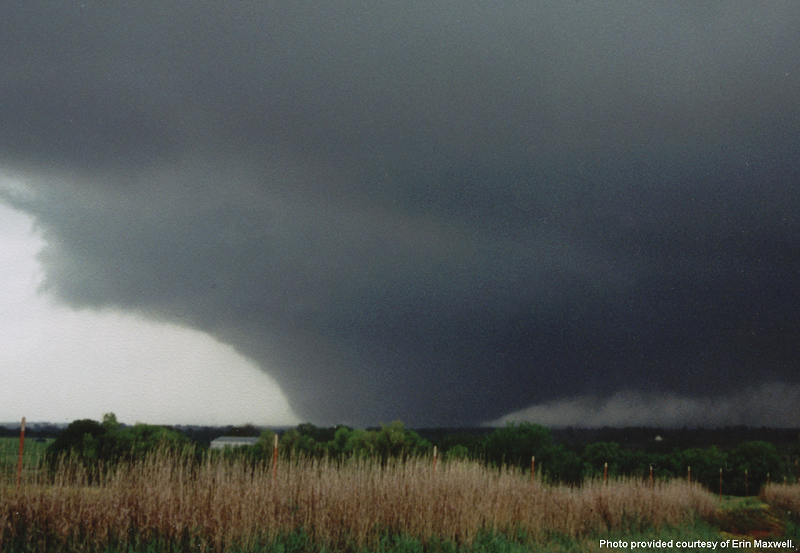
Erin Maxwell. May 3,1999 Tornado. (1999) Wikimedia
     May 3, 1999: On the evening of May 3, 1999, a large tornado touched down southwest of Bridge Creek, OK. The tornado went on through Newcastle and Moore continuing for nearly an hour and a half and traveling 38 miles. Mobile doppler weather trucks recorded wind speeds of 318 mph in the tornado. That is the highest wind speed ever recorded on earth. This was a massive EF5 wedge tornado that until this day, is still the strongest tornado ever recorded. The tornado killed 36 people in the three towns and injured around 800. There were 8,000 buildings destroyed and damage cost around $1.5 billion.


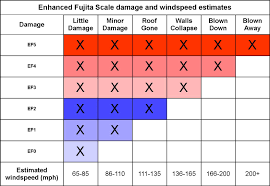
     May 8, 2003: In the afternoon of May 8, 2003, a weak tornado touched down west of Newcastle and moved northeast across the city of Moore. The tornado was rated an EF-4, which is the second highest on the scale. Despite this strong tornado, no fatalities were reported, though dozens were injured. This was the third most damaging tornado ever in Moore. The tornado caused extensive damage to homes and Tinker Air Force Base, where heavy damage was done.

     May 20, 2013: During the school day on May 20, 2013, a tornado touched down northwest of Newcastle and tracked through a very heavily populated part of Moore. The tornado was 1.5 miles wide and traveled for 17 miles. Wind speeds of over 210 mph were recorded. In the path of the tornado were 2 elementary schools, Briarwood and Plaza Towers. The tornado hit both schools directly, and at Plaza Towers, a wall in a hallway where 3rd graders were sheltering collapsed killing seven children. In total, the tornado killed 24 and injured 377. It destroyed 1,150 homes, and the cost of damage was around $2 billion.
     
      Part of Moore’s bad urban planning shows when tornadoes hit, specifically the May 20, 2013 tornado. There is no way of preventing a tornado, but we can be safer.


     When the tornado was headed toward both elementary schools, it was nearing the end of the day. The schools both decided it would be safer to keep children until the storm passed, not knowing they would take a direct hit. When the students sheltered, many were in unsafe areas, which shows in the number of injuries and fatalities in both schools. If the schools had had a tornado shelter, the injuries could have been few to none.

This is the school after it was hit
    
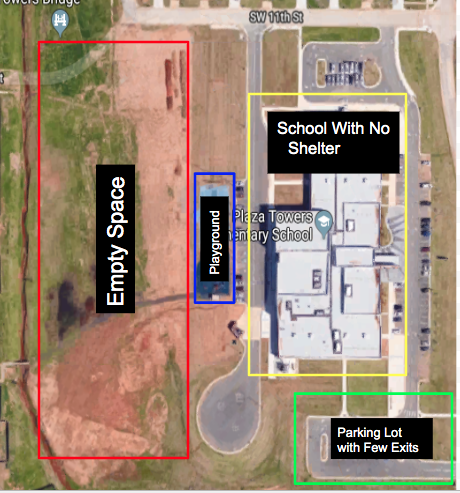
     The current school only takes up about half of the lot it sits on. The rest of the space is not being used. Houses surround the school which have all been rebuilt since the storm. This open space could be used for community shelters or other community spaces in a mainly residential area. The school itself is more modern but does not include a storm shelter. This could be dangerous and put the school in a similar situation if another tornado hits like in 2013.  The parking lot is small and does not have many exits. This presents an issue in evacuation. When the tornado was heading towards the school, the school decided to keep kids inside the school to prevent there from being further deaths in the parking lot as parents raced to pick up their kids. More driveways would provide better escape routes.


CM “Analysis” (2019)
 Here is an analysis of the existing Plaza Towers Elementary. The school was rebuilt after the tornado. In the rebuild, the design included a memorial in the front of the school which has seven benches, each representing a child who died in the tornado. The benches have the child’s name on them and are engraved with their favorite things and activities.

CM "Redesign" (2019)
     This is my redesign of the Plaza Towers Elementary. The first things I made sure to include were tornado shelters. I included one inside that is a reinforced safe room that can also be used as a classroom. I also included a large shelter outside that can be used for the school and the community. This will increase the sense of safety for parents who send their children to school, as well as for the surrounding homes. I included another safety feature for the school: extra driveways for more convenience every day and more escape routes in a tornado. I noticed how the area around the school is almost all residential. I included a community center on the empty space behind the school. The community center and school could share resources and bring the community together. There will be childcare, gathering rooms, and extra classrooms. I also put some sustainable and energy efficient improvements in the area. I included solar panels on the ground because there are no mature trees in the area because of the tornado. The solar panels can provide energy to the school. I also included a community garden for kids to learn about biology and have a hands-on learning experience. The food grown in the garden can also be used in the school lunchroom. My redesign of the school and surrounding area makes the area a safer and more sustainable place for the community.

Here is a 3D rendering of my design.

CM “3D Model” (2019)

    To calculate the area of the design we can use length x width. The length is 703.72 ft and the width is 812.08 ft. To find the area, we multiply the length and width. 703.72 x 812.08 = 571,476.938 ft^2 

    I am going to calculate the volume of the tornado shelter outside the school. The shape of the shelter is a triangular prism. To calculate the volume of a triangular prism, we can use 1/2 x B x H x L. The dimensions of the shelter are 100’ x 30’ x 10.’ to calculate the volume, we use 1/2 x 30 x 10 x 100 = 15,000 ft^3.

    I am also going to calculate the volume of the community center. The building is a rectangular prism with a triangular prism on top. To find the volume of a rectangular prism, we can use L x W x H. The dimensions of the rectangular prism is 120’ x 75’ x 14’ = 126,000 ft^3 and to find the volume of a triangular prism we use 1/2 x B x H x L The dimensions are 120’ x 75’ x 10’ so we use 1/2 x 75 x 14 x 120 = 63,000 ft^3. To find the total volume of the building, we add both volumes together. 126,000 + 63,000 = 189,000 ft^3.
 
    My redesign of Plaza Towers Elementary actually goes towards achieving the Sustainable Development Goals set by the UN. Goal 11 is “make cities and human settlements inclusive, safe, resilient, and sustainable.” My redesign specifically addresses targets 11.2 11.6 and 11.7. 

    Target 11.2: “By 2030, provide access to safe, affordable, accessible and sustainable transport systems for all, improving road safety, notably by expanding public transport, with special attention to the needs of those in vulnerable situations, women, children, persons with disabilities and older persons.” My addition of more driveways and access to the school will help relieve congestion and can be an escape route in an emergency. This makes the roads safer for everyone in the neighborhood.

    Target 11.6: “By 2030, reduce the adverse per capita environmental impact of cities, including by paying special attention to air quality and municipal and other waste management.” My design includes renewable energy sources like solar panels. The garden waste can also utilize compost, which will help the school manage its waste. This will reduce the usage of energy by the school, making the town of Moore a more sustainable place.

    Target 11.7: “By 2030, provide universal access to safe, inclusive and accessible, green and public spaces, in particular for women and children, older persons and persons with disabilities.” I added a community center as well as a garden to the empty space. This creates a place for the community to come together in a public space. The garden also provides a green space for kids to get hands-on learning experience. 

    Peter Calthorpe listed 7 principles for building better cities in the future. My re-design addresses three of these. 

#5. Connect. Increase density of road networks, limit block size. The design I came up with provides multiple routes out of the parking lot out on the street. The streets themselves are very quiet residential streets. This may seem insignificant, but it will reduce congestion, and be safer in tornado evacuation.

#2. Mix. Create mixed use and mixed-income neighborhoods. While Moore may not be a very mixed-income neighborhood, my design implements mixed land use. School, public spaces, and energy sources are all located on the same plot of land. This will reduce how much sprawl Moore will have to do in the future. 

#7. Focus. Focus density. My design focuses on the community space in that area of Moore. People in close proximity can have a community space nearby, instead of traveling to other neighborhoods, or into downtown Moore.

     The re-design of Plaza Towers brings up the painful memories from that afternoon in 2013. There are no ordinances in Moore that state that a school has to have a shelter. The schools that were destroyed in 1999 were rebuilt without shelters. Kelly Nichols, a parent of Ethan Nichols (9) decided to leave her son at school when she heard the tornado was coming. Kelly herself had attended grade school at Plaza and was the head of the school board. She had seen in person the school practice taking shelter in the school. Kelly told USA Today: "I figured the kids will be safe in school," she said. "I didn't think (the tornado) could do that to a school." Nichols soon realized that seven of Ethan’s classmates had died in the storm. The teacher, Jennifer Doan, was being hailed a hero for using her body to shield the kids from debris. Doan, who was pregnant, and two boys were trapped under a car that had been blown in by the tornado. Doan suffered multiple injuries but she and the baby were ok. It was reported that most of the children died from asphyxiation under the cinder block wall. Some died of blunt force trauma. 

President Obama hugs Amy Simpson the principle of Plaza Towers Elementary.
     My design was inspired by the state of Kansas. The state of Kansas installed 30 tornado shelters along a 236 mile stretch of highway on the Kansas Turnpike. Each shelter can hold about 15 people and there are larger shelters located under some toll booths. The Kansas Turnpike is no stranger to tornadoes. A famous video depicts a news crew sheltering under an overpass as a tornado hits. One woman was sucked out and died. In Edmond OK, the schools in the area act as shelters for the people who do not have shelter. The elementary school and the high school sheltered hundreds of people during a storm in 2008 where the town was barely missed by an EF-5 tornado. However, there are some drawbacks to public shelters. Overcrowding can be a danger. The external shelter in my design is 300 square feet. There are 500 people in the building. I estimate the shelter can fit 150-200 people. This is if one person takes up 2 square feet or a little less. It could potentially fit 300 people if needed. It is more dangerous to drive to a shelter in the midst of a tornado than to shelter in your home. Authorities call it “sheltering in place.” If the shelter has no more capacity and the tornado hits, there could be many fatalities around the shelter. Your chances of survival are exponentially better in a shelter but getting there could be dangerous. The idea of community shelter is still a very good one. They can save lives. The purpose of urban planning is to keep people safe and happy. This redesign can help the city of Moore recover from a devastating tornado that killed some of their citizens. 

     In the process of redesigning the school grounds, I encountered a lot of dilemmas. I was conflicted on how much shelter space to put without costing too much. I also wanted to make as much use of the existing school as I could. The only thing I added in the school was the storm shelter. Everything else was added on the exterior. I decided on adding an exterior shelter as well. I wanted the school grounds to be more sustainable, so I added solar panels and a garden. These are not connected to tornado safety, but they make the space greener. In conclusion, I think I made Plaza Towers Elementary a safer and greener place for everyone. 

Works Cited: 

Air Force Medical Service. “Enhanced Fujita Scale With Wind Speed Estimates.” (2019)

Allen, Silas. “Public Tornado Shelters Can Do More Harm than Good, Oklahoma Experts Say.” Government Technology.com. e.Rebuplic. Feburary 25, 2015. Web. 3, Jun 2019. 

Andrea Booher. “Plaza Towers Elementary” (2013)

Breslin, Sean. “Kansas Turnpike Tornado Shelters Offer Another Option For Severe Weather Safety.” The Weather Channel, 28 Apr. 2016. Web. 1, Jun 2019. 

Jervis, Rick. “Tornado-battered Okla. school buries first victim.” USA Today.com. May 23, 2013. Web. 3, Jun 2019.

Ks0stm. “May 20, 2013 Moore, Oklahoma Tornado.” (2013)

“May 3, 1999 Oklahoma/Kansas Tornado Outbreak.” NOAA National Severe Storms Laboratory. Web. May 31, 2019

Pete Souza. President Barack Obama Hugs Amy Simpson. (2013)
Preston, Jennifer. “Remembering Young Victims of the Oklahoma Tornado.” New York Times.com. May 22, 2013. Web. 3, Jun 2019. 

“Sustainable Development Goal 11.” Sustainable Development.org. United Nations. Web. 3, Jun 2019. 

TED. “7 principles for building better cities | Peter Calthorpe.” Youtube.com. Lesson by Peter Calthorpe. August 31, 2017. Web. 

US Department of Commerce, and Noaa. “Moore, Oklahoma Tornadoes (1890-Present).” Moore, Oklahoma Tornadoes (1890-Present), NOAA's National Weather Service, 22 Nov. 2016. Web. May 31, 2019.

US Department of Commerce, and Noaa. “The Great Plains Tornado Outbreak of May 3-4, 1999.” The Great Plains Tornado Outbreak of May 3-4, 1999, NOAA's National Weather Service, Web. 3 May 31, 2019. 

“2013 Moore Tornado.” 2013 Moore Tornado Facts and Information. TornadoFacts.net. Web. 1, Jun 2019.

In conclusion, this was a very interesting class. I learned a lot about what it takes to plan and build a city. It really opened my eyes as to why things are the way they are in a city. Most people take cities for granted. They don't question why an intersection is a certain way or why a building was built. I think it was an interesting way to think about cities. This project was challenging. It felt pretty daunting at first, redesigning a whole area. Once I got my ideas flowing, it ended up going smoothly. I am really proud of my 3D model and all the research I did. I really liked connecting my interest in tornadoes to a class. I have enjoyed my Junior year, and I feel that I have matured in my projects over time. 

Wednesday, May 15, 2019

An Electrifying Action Project!

This is the second unit of the final Junior STEAM class "Urban Planning." In this unit "Power" we learned about what it takes to power a city. We traveled back in time and learned about the "Current War" between Tesla and Edison at the Chicago World's Fair in 1893. We learned the differences between alternating current and direct current. These are the 2 ways electricity travels. Tesla discovered AC and Edison discovered DC. The competition was to see who could light up the world's fair most effectively. We also learned about the fundamentals of electricity: Volts, Amps, Watts, Ohms, etc. We learned how to draw circuit diagrams and learned how to calculate current, power, voltage, ohms, and resistance. For an FE this unit, we went to the Museum of Science and Industry. This was a 2 part FE. One reason we went to the MSI is because of its location in Jackson Park where the World's Fair took place. The MSI building is the only surviving building from the World's Fair. We are reading "Devil in The White City" which is about the World's Fair. We were able to visit the real locations we were reading about in the book. We also went to see the Tesla Coil fire and different exhibits on electricity. We also went to a maker lab where we made our own simple circuits we could wear, in the form of a light up snap bracelet. For this project, we were partnered up to create a circuit. We had to create a circuit with a certain amount of resistors and switches. Then, we had to make a cover and have each resistor represent an eco-friendly appliance to create an eco-friendly house out of our circuit. We had to calculate the voltage and resistance of our circuit, as well as the current going through each branch. My partner for this project was JN. You can view his blog by clicking on his initials.


In conclusion, this was a fun yet frustrating project. I was very happy with how well JN and I worked together. We were able to split up the work nicely and pretty much be ahead of the game throughout the whole process. Still, it was hard to create a fully functioning circuit and find 5 eco-friendly appliances and find out how much money or energy they would save. I am most proud of how our circuit cover came out. We created little paper appliances which turned out adorable. I really think we couldn't have done this project better!

Wednesday, April 24, 2019

Truss The Bridge

This is the first unit of the final Junior STEAM course: Urban Planning. In this unit called "Load", we learned about forces and load. We looked at aspects of urban planning, specifically bridges. We looked at different types of bridges and how they handle the forces put on them. Along with this, we learned about Newton's three laws of motion. We also looked at free body diagrams, which show the forces acting on an object. We also learned about equations of motion and various ways to calculate angles and sides of triangles like the Law of Sines and Cosines and Heron's formula. For an FE, we went to downtown Chicago and met with Shehara and Gabriel from Metropolitan Planning Council. We walked along the river and looked at the various bridges. We also went to Millenium Park and learned about how the city turned Millenium Park from a train yard, to a spot millions of tourists visit each year. That's what urban planning is all about. For this action project, we teamed up with our classmates to make a bridge out of nothing but popsicle sticks and Elmer's glue. We had to make a truss bridge that could hold at least 10 pounds without breaking. We had to build, analyze, and draw our bridges. You can view my partners OL and MW blogs by clicking on their initials!


You can watch us test our bridge here!


In conclusion, this was a very interesting project. I never am very fond of partner work, but I was able to work with my partners to somewhat equally spit up the work. The hardest part of this project was actually building the bridge. The glue took a long time to dry, and it was very hard to keep pieces in place. I am most proud of all the calculations my group and I did. It was fun to analyze what we actually built. I hope you enjoyed my project.

Monday, March 25, 2019

ER Thoracotomy: Is it Worth the Risk?

This term, I proposed my own independent study. We were offered the opportunity to work independently and create something of our own. I proposed a surgical science study. I spent these 9 weeks researching and learning about different procedures. I kept track in with entries in a Google Doc I made. I first researched anatomy. I looked at the anatomical landmarks of the thorax and the planes of the body. I allowed myself to drift between what kind of surgeries I wanted to study. I started out with cardiothoracic surgery. I found myself drifting toward more minor, emergent procedures. I am fascinated with emergency medicine/surgery, so I wanted to really understand the basic emergency surgical procedures. I looked at procedures like chest tubes, thoracotomy, needle aspirations of pneumothorax, and pericardiocentesis. I then found myself drifting into neurosurgery. Both cardio and neuro are at my top interest. I looked into some common neurosurgical procedures such as craniotomies and craniectomies, hemispherectomy, corpus callosotomy, lobectomy, ventriculostomy, and ventricular peritoneal shunt. I also looked at some emergency neurosurgical procedures like emergency ventriculostomy, Intracranial probe insertion. I also looked at some emergent airway procedures like cricothyroidotomy and tracheotomy. For my FE, I visited the American Hematological Society's annual hematological cancer conference ASH. My friend and classmate NB also came with me, as she is studying medicine as well. It was very technical, and I am rather ignorant when it comes to the more diagnostic side of medicine, so it was interesting to learn about. For my project, I wanted to something more than just research. I have always been interested in emergency thoracotomy, and I have heard several different sides of to argument as to whether it is safe or not. I wanted to research thoracotomies, and find some statistics, and then ask people what they thought. I hope you enjoy!

You can view my research from my independent study here.


Here is a video of me performing a Clamshell Thoracotomy.


In conclusion, this was my dream class. I am always trying to connect what I am learning about medicine because it is my passion. I wanted to flaunt my surgical knowledge, and I found some statistics, but I mostly knew all of this information already. I really was able to do what was interesting me a the moment. I wished I could have challenged myself more. Sadly, I don't really know anyone that knows more than I already do at school. I often have to challenge myself. I wish I could have talked more with my teacher, but overall, I am very happy with the work that I have done.

Works Cited:

Fallon, Brian. "Atlas of Trauma Clamshell Thoracotomy." TRAUMA.org. April 2005. Web. Feb, 5 2019.

Guthrie, Kane. "ED Thoracotomy: Is it Just The First Part of the Autopsy?" Life in the Fast Lane.com. June 2, 2018. Web. Feb, 8, 2019.

Lent S, Gretchen M.D. "Emergency Beside Thoracotomy." Medscape.com. August 7, 2017. Web. Feb, 14, 2019.

Thursday, March 21, 2019

The Essential-Clock!

This is the 3rd and final unit of the Junior STEAM course Light, Sound, and Time. In the 3rd unit, we studied time. We wrapped up the mini-lessons. These were a series of lessons that each student gave about a chapter of a book they read in each unit. I this unit we discovered latitude and longitude, and how to calculate your location without a clock using Greenwich Mean Time (GMT). We learned about the Prime Meridan as well as the International Dateline and all about timezones. We also learned about pendulums and how they can be used to tell time. We mainly focused on the Foucault Pendulum, which is a pendulum that used the earth's rotation to tell time. We also looked at the different ancient time telling devices like sundials. We also studied the universe and dark matter and wormholes. We also learned some math concepts like calculation arc length and angle in a circle, as well as calculating vertexes. We visited the Adler Planetarium where we learned about the universe. We looked at different planets calculations, and we saw how time has affected culture and we looked at other historical devices. For this action project, we had to come up with our own time telling device. It could be inspired by an old way of telling time, but we had to make it better We then had to make a video advertising the product.

You can view the script of my video here


In conclusion, this was a pretty difficult project. I really struggled coming up with something that wasn't already come up with. Making the video was also pretty difficult. I kept messing up on the voice over and having to restart. I am proud of how my video came out as it is clear and well put together. I really enjoyed this class and I am happy with how I did. I learned a lot in this class about how we perceive the world, and I definitely see the world different now.

Works Cited:

Bendini A. Silvio. "Measurement with Insense in Japan." Japanese Insence.com. Cambridge Press. 2002. Web. 21, March 2019.

Sunday, March 10, 2019

DIY Guitar

This is the 2nd unit in the Junior STEAM class, Light, Sound, and Time. The second unit was focused on sound. We learned all about sound and how it can be applied to the real world. We studied how light and sound are related, and how to calculate the distance it takes sound to travel. We learned about things like the Doppler effect and sonic booms, where sounds that are moving have a different pitch, or what happens when something travels faster than sound. We also studied how our ears perceive sound and the human threshold of hearing. We looked at the anatomy of the human ear and studied sound waves and measured them. To prepare for our action project, we went to the Chicago Music Exchange to learn about guitars and other instruments and how they produce sound. We were able to play instruments, and talk to experts about how the different instruments produce sound. For the action project, we made our own guitars or Diddley Bows. This is a one-stringed guitar made out of different household materials. The made the Diddley Bow, and then recorded ourselves playing it, and we drew the harmonics the played. We also calculated the length and angle of the guitar and the volume of the resonator.

CM "Diddley Bow" (2019)
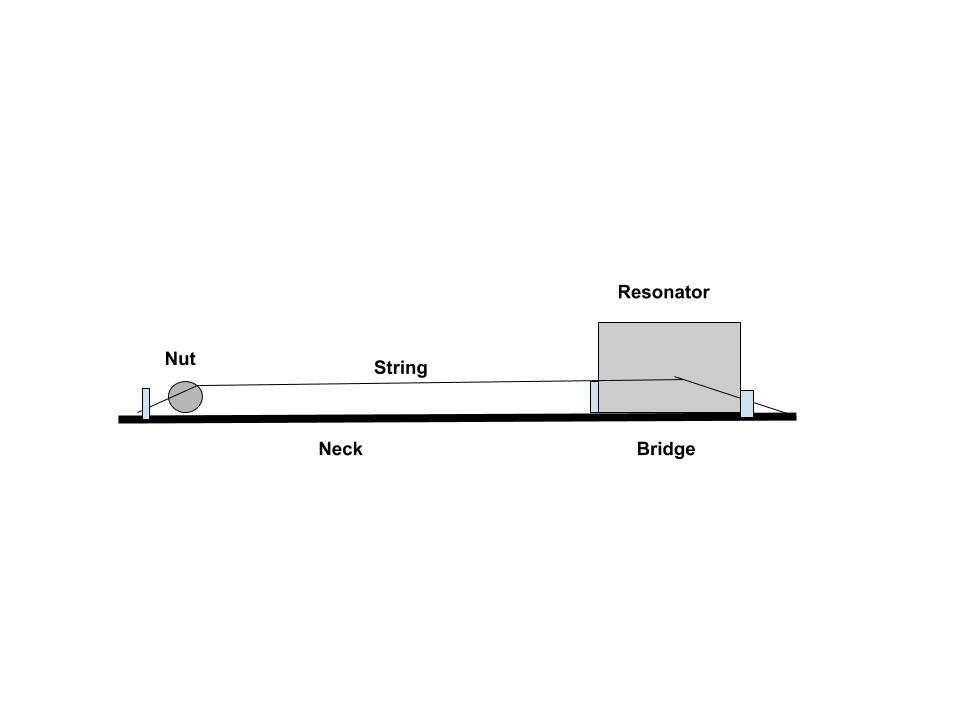
The instrument I made is called a Diddley Bow. It is a type of homemade guitar. It is made out of wood, a tin can, batteries, and guitar strings. The diddley bow can be as little as 1 string, or as many as 6. Diddley bows also have varying amounts of detail and features. My Diddley bow was made by using a 2 x 4 piece of wood and measured where I wanted the nut to go. The nut was made by using a dead AA battery. I then used a tin can as the body or the resonator of the Diddley Bow. I poked a hole in it, and then threaded the guitar string from the nut through the resonator and then tied it around the screw at the base of the resonator. I made sure that the string was taught enough to make loud enough sound but that it wasn’t too taught to play.


The Diddley Bow produces sound by vibrating the string. The string’s vibrations are amplified by the resonator or the body which is made out of a tin can. The pitch can be changed by tightening or loosening the screw that the string is attached to, like a tuning peg. Or shortening the length of the string. The volume can be changed by how hard the string is plucked. This changed the amplitude of the wave that the string makes, producing a louder sound. The width of my string is 0.05 in.
CM "Diagram" (2019)


My Diddley Bow demonstrates wavelength and frequency by manipulating the strings. When the strings are plucked, a standing wave is produced. This is how sound is portrayed in waveform. The longer the wavelength, the lower the frequency and vice versa. Pitch is how our ears perceive frequency, the higher the frequency of a wave, the higher pitch it will sound. If the string is plucked and produces a high-frequency wave, a higher pitch sound will be created. If the wave has a lower frequency, it will produce a lower pitch sound. This is how the Diddley bow is played so it can produce different pitches.

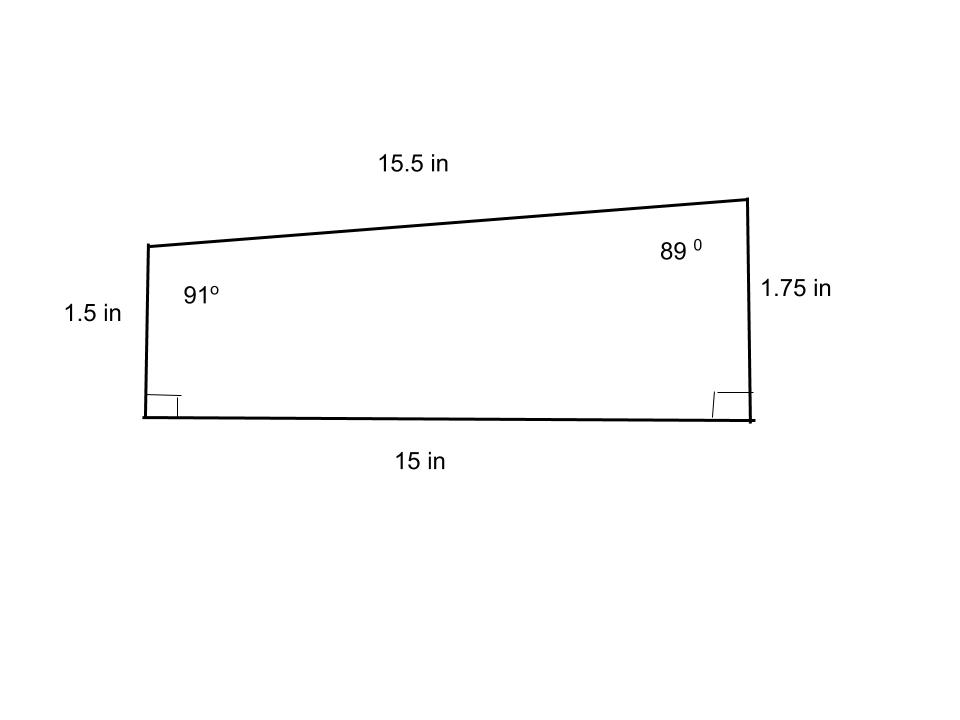
Here is a recording of me playing the Diddley Bow The side view of the guitar created a trapezoid with an area 15 x (1.5 + 1.75) / 2 = 1.625 x 15 = 24.375 sq in. I figured out how to find the angles by dividing the trapezoid into a rectangle with a triangle on top, with a base of 15 and a height of .25 and a hypotenuse of 15.5. To find the upper right angle, I calculate tan -1 (15 / .25) = 89 degrees. The left angle of the triangle is 1 degree because 89 + 90 = 179 which is 1 short of 180 degrees. This means the left angle of the trapezoid is 91 degrees because 1 + 90 = 91.

    CM "Trapezoid" (2019)

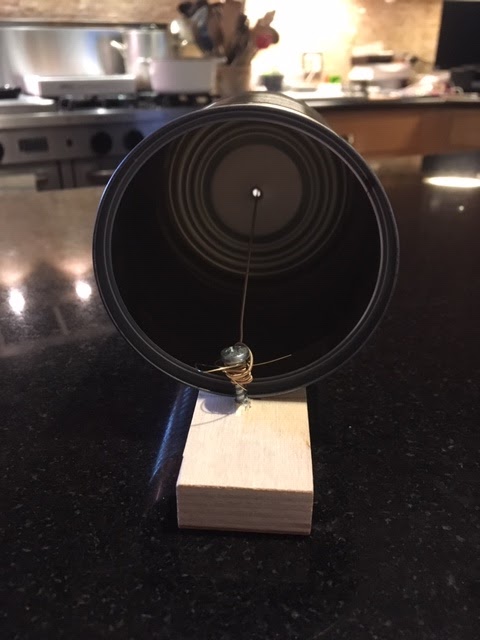
The tin can I used as a resonator has a radius of 1.75 in. To calculate volume, we need to know the area of the circle and the height. The area of my circle is π 1.75 ^2 = 9.62 cubic in. The height is 4.5 in so the volume is 4.5 x 9.62 = 43.29 cubic in

CM "Resonator" (2019)

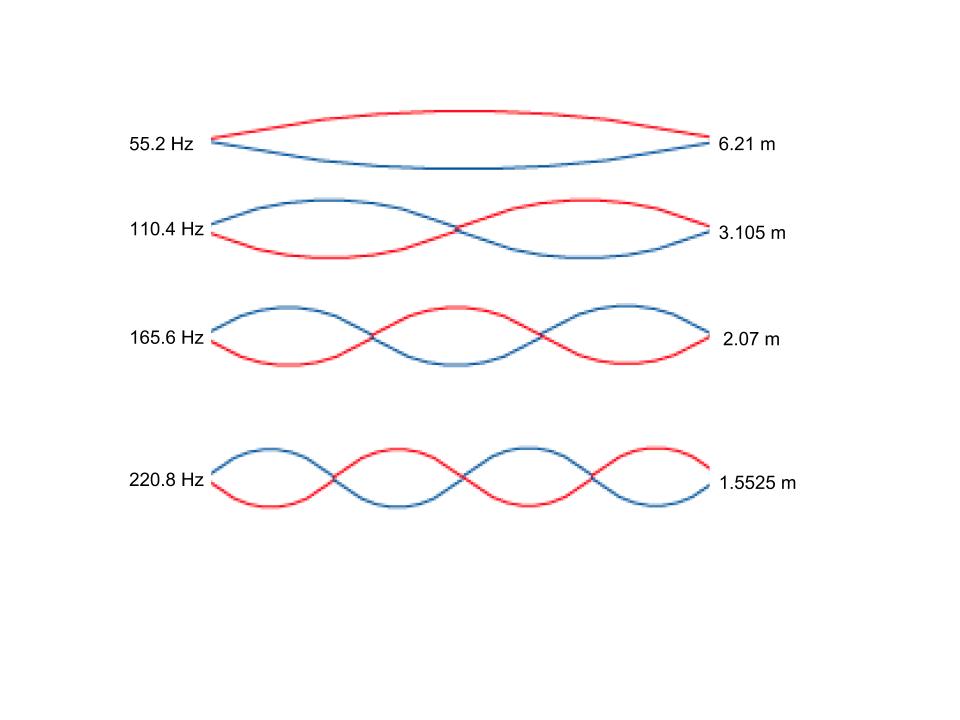
My Diddley Bow plays 4 harmonics. I found the frequency of my Diddley Bow which was 55.2 Hz (Hertz) I then found the wavelength. The speed of sound is 343 m/s so 55.2 Hz / 343 m/s = 6.21 meters which is my wavelength. As Frequency gets larger, the wavelength gets smaller.

The 1st harmonic represents the open note.

The 2nd harmonic represents the ½

The 3rd harmonic represents the ⅓ and ⅔

The 4th harmonic represents the ¼ and ¾


Frequency = 55.2 Hz Wavelenth = 6.21 meters

Frequency x 2 = 110.4 Hz Wavelength / 2 = 3.105 meters

Frequency x 3 = 165.6 Hz Wavelength / 3 = 2.07 meters

Frequency x 4 = 220.8 Hz Wavelength / 4 = 1.5525 meters

CM "Harmonics" (2019)

In conclusion, I liked this project. I thought it was an interesting hands-on way to learn about sound and sound waves. I enjoyed making the Diddley Bow as well as calculating it. This was a challenging project as I had a lot of other things going on, but I am proud of how the Diddley Bow actually came in the end.


Thursday, February 14, 2019

Pictures Out Of Thin Air

This is the first unit of my Junior STEAM course Light, Sound and Time. In the first unit, Light, we learned about, well, light! We learned about the electromagnetic spectrum and light waves. We also worked on trigonometry where we studied unit circles, similar triangles, and sine and cosine waves. We also studied radians and degrees, as well as Snell's Law of refraction. We only went on one Field Experience this unit. We went to The Latin School, where we met with their photography teacher Ms. Ross. We used their darkroom to develop our pictures. This was a very important FE, because we couldn't have done the Action Project without her and the Latin School's support. We also did an experiment where we saw which lamp would raise the temperature of a piece of chocolate the most. This was so we could further understand how light and energy interact with different objects. For the first AP, we made a pinhole camera. We made the cameras in class and then took them to The Latin School where we took and developed the photos. We then had to calculate the light and distance between the lens and the object we took a picture of.

CM "Pinhole" (2019)
What exactly is a pinhole camera? A pinhole camera is a type of simple handmade camera. It consists of a lightproof box, a manual shutter, and a lens. The pinhole camera can take pictures by placing an object in front of the camera and putting film inside the camera. Then, you let light through the pinhole which lets a small amount of light into the completely dark camera, where the image transfers to the film. The film is then developed, and if it works, you are left with an image. It is important that the inside of the camera is all black so it is completely light proof. The black inside of the camera makes sure all the light is absorbed and the only light coming through is through the pinhole. The pinhole camera does not refelct or refract light because light is not bouncing off anything, nor is it entering a different medium. This is the same principle as the camera obscura. This was a technique that painters used hundreds of years ago to paint realistic pictures. They would have an all dark room where there is only a small hole that lets light in which will project the image outside onto the back wall. The light that comes into the camera is part of the visible spectrum on the electromagnetic spectrum. This is a spectrum of wavelengths that includes everything from gamma rays to radio waves. The light acts as energy when it moves into the pinhole of the camera. Light can act as both a wave and a particle. This is because rays of light can pass through each other on not bounce off. Light acts as a particle because when it hits metal, the light is absorbed.

For this project, I used an empty oatmeal container. I punched a hole in it and then painted the inside black with black acrylic paint. I also painted the top so the whole thing would be lightproof. I then took an empty soda can and cut a circle out of it with an X-Acto knife. Then I used a pin and poked a hole through the aluminum. Then I sanded it with sandpaper so everything was smooth. This is the lens. I taped the lens behind the hole in the container and added another coat of black paint. Then I created a shutter out of black duct tape.
CM "Diagram" (2019)

CM "Developed Photo" (2019)
CM "Black" (2019)
When we went to the dark room at the Latin School. I did everything I could to produce a picture. I tried twice, but both attempts did not turn out. The first one was all black which most likely means it was overexposed, even though the shutter speed was the recommended time. Shutter speed is how long the lens was letting in light for. For the first attempt with the plain white background, the recommended shutter speed was 3.5 minutes, which I followed. The second attempt had a checkered background which was 5 mins, which I followed. I also left the photo in the chemicals for the right amount of time. The second attempt, I chose the background that needs a longer shutter speed. I did this for the correct time as well, but this one also did not turn out. My best guess is that both attempts were overexposed. I don't know why, but I think I left them both out for too long.

CM "Camera" (2019)

Here are my calculations showing the light rays interacting with my object.

Distance From Film to Pinhole (Diameter): 4 in

Pinhole Height: 3.25 in

Total Camera Height: 7 in

Curved Hemostat: 5 in

CM "Calculations" (2019)
In the end, I really liked this project. It was very hands-on and we actually got to make something that may or may not work. This was a challenging product because we had to go somewhere else to do this project on a very limited time schedule. This meant that I only got 2 tries out of my camera with very little time to focus. This was a very unique challenge, and it made me think and work hard to figure out why my camera didn't work. I am proud of how my camera was designed, but I still don't really know why it didn't work.

Friday, January 18, 2019

Plastic Straws Begone

In the last unit of my elective class Biomimicry, we learned about fungi. We learned the different parts of a mushroom, and different decomposers and detritivores as well as composting and decomposition. We also learned about closed loop economies and closed loop systems versus linear economies. This is the difference between a product that supports itself and can be upcycled, or a product that is used and then discarded. Our class visited The Plant Chicago to learn about aquaponics. We toured their facility and did our own design activity. We also visited Interface, which is a sustainable carpet company founded by Ray Anderson. We learned about what it takes to make a large company sustainable. For this project, we picked a product to redesign. We had to research how the product is made currently, and then redesign our product to make it a closed loop system. We then compared it to Interface's "Mount Sustainability." This is a set of goals that interface set to become the most sustainable company, My project was actually able to reach the top of the mountain.


I did like this project because it was more of a redesign of an existing product rather than a total redesign. I am proud of the research that I did because my family has recently given up plastic straws. My favorite part of this project was drawing the systems. I liked this because it was more hands-on than just doing a slideshow. This project made me realize more and more that we need a solution to plastic straws. I think there are enough ways to make straws sustainable and eco-friendly, but everyone needs to come together to make it a reality.

Wednesday, December 19, 2018

Can Animals Help Us Live Sustainable Life?

For our second action project for my elective class, Biomimicry, we created designs of homes and transportation inspired by animals. In the second unit, we focused on the animal side of Biomimicry. What can we learn from animals? We discovered that we can learn from animals through Biomimicry in 3 ways: Form, Process, and Ecosystem. These are the 3 things we are inspired by. Form - the build or physical structures of the animal. Process - the behavior or processes of animals. Ecosystem - how animals interact with their environment. We also looked at how different animals move and build. We studied how wings work with Bernoulli's principle and lift, weight, drag, and thrust. We had a guest come in from Biomimicry Chicago. She showed us various animals skins, and how these skins show adaptations. She also lead us in an exercise of Biomimicry. For our action project, we had to create an architectural design and transportation design. I picked the Namibian Beetle, and the Shovel Snouted Lizard. We had to make a design, and then draw a diagram and build a model. I am proud of how my project turned out!


In the end, I really enjoyed this project. This was probably the most work intensive AP I have ever done. I was a lot of work, but it didn't feel overwhelming. I liked the challenge of this project. Unlike the last Biomimicry Ap, I really liked both of my ideas. I thought both of them were very strong and very practical. I wish my model turned out a bit better and that I could have added more detail, but we only had about 2 hours to build a full model. I am proud of this project and I thought it was very though provoking.

Wednesday, November 28, 2018

Baobab Cat Tree


In my Junior STEAM elective, Biomimicry, we learned about designs based on nature, specifically plants. In the first unit, Like a Plant, we studied different plants and their survival and evolution tactics and how they evolved with the certain traits they have. We also looked at evolution to see how different species evolved to survive over time. We looked at different products made that were inspired by plants. We traveled to the Lincoln Park Conservatory to study different plants and their traits. We also studied the Fibonacci sequence, which is a sequence of numbers commonly found in nature. For this action project, we were asked to either think of a human challenge and find a plant that could help solve it, or find a plant, and design a product inspired by that plant. I chose the latter. I was watching my cats play at home, and I was thinking about their cat tree, so I decided I would try to come up with a creative and more sustainable idea for a cat tree. I found the Baobab Tree, which is a tall tree that has an ecosystem of its own. I enjoyed this project, but it did challenge me to think outside of the box. I hope you enjoy my design.


In conclusion, this product was somewhat challenging for me. I learned more about design than I did plants, but it was still very useful. I really had to think outside the box for this project, as I really didn't have any solid ideas for a design until I saw my own cats playing around. I am proud of the design, although it is more of a novelty than I would have liked it to be. I have gotten positive feedback, but I maybe would have liked to think of a more useful product. In the end, I am happy with how this project turned out, and I liked that I was challenged more than I usually am. 

Wednesday, May 30, 2018

Get the Crud out of Your Blood

Sadly, this is my last Unit in my favorite class, Cure. In this last unit, we learned about prevention of diseases. We didn't have very much time to complete this unit, so we did some math concepts like probability, to relate to the probability of contracting diseases and medications working. We also created a family tree for ourselves to look t any diseases that are present in our family. I liked this activity because I got to learn more about my family and what they were affected by. For our field experiences, we had a certified Yoga Nidra instructor come in and guide us through a meditation session. This was to show us alternative ways of healing other than medication or surgery which we covered in our previous unit. I thought this session was relaxing, although, I couldn't really get into the meditation but I enjoyed seeing ways of healing that I am unaware of. For this action project, we combined pretty much everything we learned in Disease and Cure. We were essentially playing doctor. We had to create a patient profile for a fictional person, that could be based on someone real. For my purposes, I chose someone fake. In this profile, we had to discuss their history, their main concerns and the reason for a consultation. We had to make recommendations to the patient about their lifestyle, their diet, and other therapies we wanted them to do. I chose to create someone with a risk of deep vein thrombosis (DVT) and pulmonary embolisms (PE) because I am very interested in vascular surgery.


In the end, I am very sad that this class is over, as it was my favorite I have ever taken at GCE, and probably will ever take. I am so grateful I got to participate and share my knowledge. I really liked this action project because it was a very nice closure to both Disease and Cure. It incorporated most things and really had us show off what we learned in these classes. I had some trouble with making up a person for this project because the original person was based off a real person who had a rare syndrome but it didn't really affect his life so it would have been hard to do. I am very sad that this class is over, but I toughly enjoyed it, and I am very proud of all the work I have done.

Marine Biodiversity Literature Review

It's officially my last action project at GCE! I've done over 80 action projects and here is my last. This project is for my last Se...