About Me

I am a student at GCE Lab School in Chicago. This is my blog to show all my work.

Pages

Friday, September 27, 2019

Landing a Cure for Cancer

Welcome to the first unit of Journalism, the first senior humanities course. In the first unit, we explored the news values. These values are impact, immediacy, prominence, proximity, and conflict. These represent the values of any news source. We looked at these values in specific examples from news articles from all different time periods. In my article, I specifically used the value of impact. I wrote about the impact of an event on the community. We went on a field experience to the Newton Wienberg Gallery to look at a photography exhibit. For this action project, we had to write our own article on a specific event or conflict. My best friend Lily, who I have skated with for a long time with was diagnosed with thyroid cancer. My skating rink put on a benefit to raise money for cancer research. I chose to write about this event as it was an important event for the community. I really liked this project and I am very proud of how it came out. 

Landing a Cure for Cancer
By: CM

In Oak Park, there is a dedicated group of figure skaters. This group practices diligently at Ridgeland Commons Ice Arena in Oak Park. In a sport as intense and strenuous as figure skating, people become close. The skaters at Ridgeland are like a family. Practicing, performing, and competing together. So when someone in the community needs support, people come together.
The flyer for the event.
Lily Scully "Flyer" (2019)


16-year-old Lily is an active participant at the rink and has been skating for many years. In March of 2019, Lily was diagnosed with thyroid cancer. She had always known something was wrong. She has always been prone to sickness. She hadn’t been feeling right for over a year when she noticed the lump growing on her neck. “I just knew it was something,'' said Lily. She asked one of her fellow skaters who studies medicine what she should do. It was suggested that she see a specialist, who then made the diagnosis. When she broke the news to her fellow skaters, they knew they had to support her through her journey.

The thyroid is a small butterfly-shaped gland in the neck. The purpose of the thyroid is to regulate hormones. The 2 hormones produced by the thyroid are Triiodothyronine (T3) Thyroxine (T4). These hormones help regulate how the body uses its energy. According to the Thyroid Cancer Survivors Association, there are 15.4 cases per million adolescents ages 15-19. Females are slightly more at risk for thyroid cancer. Lily had to undergo a thyroidectomy where her entire thyroid was surgically removed, as well as radiation therapy. Since she had her thyroid removed, Lily will have to take medication to replace the job of her thyroid for the rest of her life.

The community came together to put on an exhibition on Saturday, September 21. The goal was to raise money for the Wellness House in Hinsdale and ThyCa association. The proceeds will help the Wellness House expand their teen programs, and will help ThyCa research cancer treatment. “Even though I am sick, I am so happy to be able to give back to the people who have helped me,'' said Lily.
The event was organized by Lily and her parents, as well as her coach and other rink staff members and friends. The event was a big success. There were raffles and a silent auction, as well as free food and drink donated to the event. The event attracted many people, the lobby was filled with people mingling and buying raffle tickets. The main event was a skating exhibition where 30 of Lily’s fellow skaters paid tribute to her by skating to her past music. This was a surprise to Lily. “I had no idea what was going on! I only noticed when they started skating to my solo music. It was so special.”

The night ended with a celebration of Lily. The raffle winners were announced, and silent auctions were closed. Lily and her family were embraced by the supporters. “This truly means everything to us.” said Tim Lily’s father.” “When your community comes together, it’s incredible. The support shown for Lily is more than we could have asked for.” Cathy Brown, Lily’s coach helped coordinate the event. “This is so important to raise awareness for. I’m so happy we can raise money to find a cure.” By the next day, the total money raised was over $15,000 which was donated to both the Wellness House and ThyCa.

Lily, third row, far right, and her friends from school in the stands at the event.
Margaret Scully "Friends" (2019)

In the end, I really enjoyed this project. I liked how I was able to cover something in my personal life that I care deeply about. I am happy with the quotes I got, and I am very happy with how the event turned out. We raised $15,000 for cancer research, and for the Wellness House. I hope I can do more action projects relating to my personal life in the future!

Thursday, September 5, 2019

Summer Volunteering in my Hometown

Over this summer, I spent most of my time in my home town as I usually do. I am from a very small town in Wisconsin called Bayfield. It's as far north as you can go on the shores of Lake Superior. My dad's side of the family is all from this area. One of my great grandfathers was a commercial fisherman on the lake, and the other was a doctor who ran the tuberculosis sanitorium in town. My family has a very deep history in this town and I have learned a lot about it in my years of growing up both there and in the Chicago area.

CM "House" (2019)
This summer was different than summers in the past. I usually spend summers in Bayfield and in the past few years I have worked at various restaurants while living with my grandparents and spending time with friends and family. This year, my grandfather's health was declining. This meant they couldn't stay for the whole summer. I had spent some time with my family as a family vacation but then went back to Chicago with my grandparents. I then went back up north with my grandparents and my dad in early August. My grandparents both work closely as volunteers with the local historical association. The Bayfield Historical Association. The BHA as it is known around town is a non-profit organization founded in the 1980s. My grandparents have been with the organization since it's founding. There is a museum in town that has different exhibits about the history of Bayfield. These include the history of the islands, fishing, logging, hunting, the great flood and more. Recently, the BHA acquired a model train from a local man named Larry Wrighton. The Wrightons are a local family with deeps history in Bayfield, as well as my names (LaPointe and Moody). Larry Wrighton created a to-scale model railroad of historic Bayfield in the 1920s. He had been working on this project since the early 1990s. He donated it to the BHA in 2016. The BHA took it apart and put it back together in the basement of the museum as an exhibit on historical Bayfield.

My job was to be a docent at the exhibit. I already knew a lot about the history of Bayfield, so I was oriented by a long-time friend Bill Gover. He told me all about the trains and how they were made and assembled. I then had my first shift. I would show visitors the train and the town and tell them about the history of Bayfield. I answered their questions and told them about my family and my own history in Bayfield.

I thought this was a very cool experience I was able to have. I got to learn more about my town's history and got to educate tourists on how special this town really is. I got to make more connections with friends and the management at the BHA. In the end, this was a very fun and meaningful way to spend some of my time over the summer.

CM "Deer" (2019)


Monday, June 10, 2019

Fostering Kittens

Katie Moody. "Lector"(2018)
The big service project I did this year was fostering kittens. My family has 2 adult cats that we adopted when they were kittens. We all missed having kittens around, and when we heard about the Animal Care Leauge's foster program, we wanted to go try it out. The Animal Care League is an animal shelter in Oak Park. They have dogs, cats, rabbits, and other small animals. In August, we met with Allan, the director of the cat program at the shelter. He told us they had just brought in a kitten from the streets who has chewed on an electrical cord and got shocked. He has burns on his mouth and neck from the shock. The kitten's name was Lector, but we changed it to Oliver. Oliver is a little white and tabby cat with a ton of energy. He has to wear a cone around his neck for part of the time while his burns healed. We took Oliver home and set him up. We would give him antibiotics every day, and played with him constantly. He was a very sweet little cat. We had him for about 2 weeks. By the time he went back to the shelter, he was much healthier, and many of his burns had healed. This was a very fun and successful foster.

Meredith Moody. "Lexi" (2018)
Later in September, we received an email from Allan that they had just found 2 very small kittens on the street. They were too little to stay in the shelter, so they needed a home for them. We went that afternoon to pick up 2 tiny adorable kittens named Lexi and George. They were both about a month old. These were some of the smallest kittens I had ever seen. They only weighed 1 pound! We started to encounter problems when we got home. Lexi had really bad diarrhea. We thought it was just from stress, or from eating actual kitten food for the first time. These kitties had only every drank their mom's milk, or eaten what they could find. We could tell right away that George was doing better than Lexi. George was a typical high energy kitten running and jumping.

Lexi was very lethargic and just wanted to be held and cuddled. We weren't immediately concerned because we thought she was just having a harder time adjusting than her brother. We started worrying when she wasn't eating or drinking. She continued to have diarrhea, but not drinking anything. This is not good because she was very dehydrated. We took her to the shelter because they have a vet. They said she was dehydrated and had some sort of intestinal virus. They gave her intravenous and subcutaneous fluids to rehydrate her. They also gave us some medicine for her intestinal problems and gave her some really rich food so she would eat it. We would take her back every day for intravenous fluids, and to check on her. She started eating and drinking again. She had a very good appetite and would try to steal her brother's food. She was doing so much better. Unfortunately, the next morning, my mom found Lexi in her bed not breathing. Sadly, she had died in her sleep. We felt very sad. She was getting better but still died. We took peace in the fact that she wasn't suffering anymore, and had seemingly just stopped breathing in her sleep. The vet wasn't sure why exactly she died. they thought she may have had a common virus in kittens that can be fatal. She was tested, and it was negative, but it may have been a false negative, or she hadn't contracted it yet.

Katie Moody. "George" (2018)
George did not seem affected by his sister's death. He continued to be a happy healthy kitten. As George got older, the vet told us he had to be neutered. This was mid-October and he was about 2 months old. We took George in for his surgery and came back to pick him up later. When we got back, the surgeon had some news for us. The surgery went perfectly, but it turns out George was a girl! They ended up spaying her instead of neutering. This was quite surprising. To this day, we still don't know if Lexi was a boy, or if they were 2 girls. The shelter originally told us that it was a boy and a girl. Lexi had longer hair, and George had short hair. They said the long-haired one was a girl. This didn't change much. We started calling her Georgie instead of George. Georgie was a crazy kitten. She loved to run and play and especially loved to play with toys. We would let her run around the house and explore. She liked to play with the TV when it was on. She liked the moving figures. We ended up having Georgie for a total of 2 months and 1 week. We took her back to the shelter, and she was adopted by a young couple almost immediately. In conclusion, this was a very emotional, and trying experience. Taking care of such an innocent creature takes a lot of time and energy. I think this experience has helped me learn more about empathy in my medical career. This was a fun and intense experience that I definitely want to do again.

CM "Georgie" (2018)

CM "Oliver" (2018)

Volunteering at Paws Chicago

Over the course of this winter and spring, I volunteered at Paws Chicago. Paws is a no-kill shelter in Lincoln Park. They also have locations in Little Village and Highland Park. Paws has a program in which minors can volunteer with their parents. I am only 17, so I couldn't volunteer alone, my mom had to do it with me too. The program is for kids ages 12-17. We took a training course where the staff shared the basic rules and regulations and showed us around the facility. We signed up online for different shifts. Paws offers many different shifts at all different locations. These include reading to the animals at the surgical center in Little Village or being a door greeter at the Lincoln Park location. You can also volunteer to clean animal rooms and socialize animals. My mom and I first took a greeter shift. This was a 3-hour shift that consisted of standing in the lobby and directing people depending on what they were looking for. The Lincoln Park location is very busy, especially on the weekends, so we kept busy. We were able to help people fill out adoption surveys, and directed donations that people dropped off. The next time we went we did a cleaning shift. The first part was cleaning the cat rooms. We would mop the floors and clean the bedding and change the litter. We also got to socialize the cats in the shelter which was a lot of fun. We helped clean dishes and wash beds. We also got to clean the dog rooms while they were on walks. This consisted of spraying down the room with water and soap and use a long brush to scrub the floors and walls. Then, we would use a squeegee to drain the water. The most fun part about this whole job is the socialization of the dogs and cats. On this particular shift, we got to socialize a group of 3 labrador mix puppies. They were absolutely adorable. They were about 9 weeks old and cute as can be. We played with them, and then when they got tired, they slept on our laps. This was definitely the best part of volunteering. If you want to learn more about Paws click here. If you would like information about volunteering click here. 
Katie Moody. "Puppies" (2019)

Katie Moody. "Puppy Pile" (2019)
Katie Moody. "CM and Puppy." (2019)

Wednesday, June 5, 2019

This Design Will Blow You Away

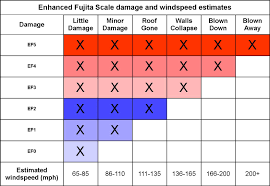
It's finally the end of the year! This is the final AP for the Junior STEAM course, Urban Planning. In this last unit, "Flow," we learned about the history of urban planning. We looked at different cities and how they grew over the years. Some cities had planned growth and some grew organically. We also looked at some old laws regarding settlements and early urban planning. We also went back to geometry. We learned how to calculate the volume, area, and surface area of different buildings on a large scale. We watched a few different TED Talks from different experts on urban planning. This was an interesting way of seeing different ideas and perspectives from different cities. Surprisingly, this class got pretty heated. A lot of people had a lot of different opinions about cities, and we didn't always agree. We went on an FE to the Chicago Pedway. This is a series of underground tunnels connecting different subways and buildings. We took a tour with a professor who told us about the history and usage of these tunnels. This was a cool way to experience urban planning close to our school. For this action project, we had to pick an existing space somewhere in the world and re-design it. This was a pretty daunting task. I chose to redesign Plaza Towers Elementary School in Moore, Oklahoma. This suburban school was hit by an EF-5 tornado in 2013 killing seven children. I have always been fascinated by tornadoes, and I had heard about this story many times before. I thought this would be a good way of joining my interest in tornadoes with urban planning. I hope you like it.

     The area I will be redesigning is Plaza Towers Elementary School in Moore, Oklahoma. Moore is a city in central Oklahoma. It is a suburb of Oklahoma City and is located just south of downtown. The town was incorporated in 1893 and was a railroad city named after Al Moore, a railroad employee. 

Population: 60,451
Land Area: 22.2 square miles
Mayor: Glenn Lewis
City Manager: Brooks Mitchell

     When it comes to tornadoes, Moore has had unfortunate luck. Since records began in 1893, there have been 24 confirmed tornadoes within the 22.2 sq mile city. In fact, the strongest tornado ever recorded went through Moore in 1999. Moore has suffered three violent tornadoes in its time killing many and causing great damage. 
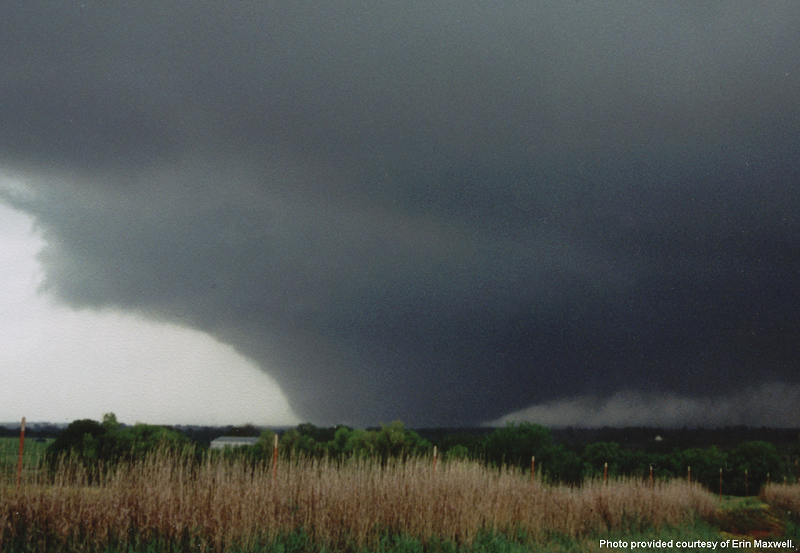
Erin Maxwell. May 3,1999 Tornado. (1999) Wikimedia
     May 3, 1999: On the evening of May 3, 1999, a large tornado touched down southwest of Bridge Creek, OK. The tornado went on through Newcastle and Moore continuing for nearly an hour and a half and traveling 38 miles. Mobile doppler weather trucks recorded wind speeds of 318 mph in the tornado. That is the highest wind speed ever recorded on earth. This was a massive EF5 wedge tornado that until this day, is still the strongest tornado ever recorded. The tornado killed 36 people in the three towns and injured around 800. There were 8,000 buildings destroyed and damage cost around $1.5 billion.


     May 8, 2003: In the afternoon of May 8, 2003, a weak tornado touched down west of Newcastle and moved northeast across the city of Moore. The tornado was rated an EF-4, which is the second highest on the scale. Despite this strong tornado, no fatalities were reported, though dozens were injured. This was the third most damaging tornado ever in Moore. The tornado caused extensive damage to homes and Tinker Air Force Base, where heavy damage was done.

     May 20, 2013: During the school day on May 20, 2013, a tornado touched down northwest of Newcastle and tracked through a very heavily populated part of Moore. The tornado was 1.5 miles wide and traveled for 17 miles. Wind speeds of over 210 mph were recorded. In the path of the tornado were 2 elementary schools, Briarwood and Plaza Towers. The tornado hit both schools directly, and at Plaza Towers, a wall in a hallway where 3rd graders were sheltering collapsed killing seven children. In total, the tornado killed 24 and injured 377. It destroyed 1,150 homes, and the cost of damage was around $2 billion.
     
      Part of Moore’s bad urban planning shows when tornadoes hit, specifically the May 20, 2013 tornado. There is no way of preventing a tornado, but we can be safer.


     When the tornado was headed toward both elementary schools, it was nearing the end of the day. The schools both decided it would be safer to keep children until the storm passed, not knowing they would take a direct hit. When the students sheltered, many were in unsafe areas, which shows in the number of injuries and fatalities in both schools. If the schools had had a tornado shelter, the injuries could have been few to none.

This is the school after it was hit
    
     The current school only takes up about half of the lot it sits on. The rest of the space is not being used. Houses surround the school which have all been rebuilt since the storm. This open space could be used for community shelters or other community spaces in a mainly residential area. The school itself is more modern but does not include a storm shelter. This could be dangerous and put the school in a similar situation if another tornado hits like in 2013.  The parking lot is small and does not have many exits. This presents an issue in evacuation. When the tornado was heading towards the school, the school decided to keep kids inside the school to prevent there from being further deaths in the parking lot as parents raced to pick up their kids. More driveways would provide better escape routes.
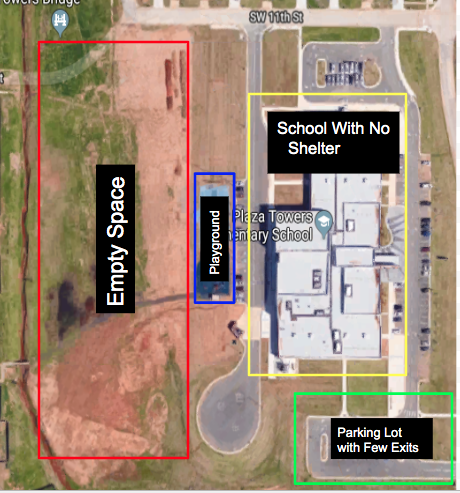

CM “Analysis” (2019)
 Here is an analysis of the existing Plaza Towers Elementary. The school was rebuilt after the tornado. In the rebuild, the design included a memorial in the front of the school which has seven benches, each representing a child who died in the tornado. The benches have the child’s name on them and are engraved with their favorite things and activities.

CM "Redesign" (2019)
     This is my redesign of the Plaza Towers Elementary. The first things I made sure to include were tornado shelters. I included one inside that is a reinforced safe room that can also be used as a classroom. I also included a large shelter outside that can be used for the school and the community. This will increase the sense of safety for parents who send their children to school, as well as for the surrounding homes. I included another safety feature for the school: extra driveways for more convenience every day and more escape routes in a tornado. I noticed how the area around the school is almost all residential. I included a community center on the empty space behind the school. The community center and school could share resources and bring the community together. There will be childcare, gathering rooms, and extra classrooms. I also put some sustainable and energy efficient improvements in the area. I included solar panels on the ground because there are no mature trees in the area because of the tornado. The solar panels can provide energy to the school. I also included a community garden for kids to learn about biology and have a hands-on learning experience. The food grown in the garden can also be used in the school lunchroom. My redesign of the school and surrounding area makes the area a safer and more sustainable place for the community.

Here is a 3D rendering of my design.

CM “3D Model” (2019)

    To calculate the area of the design we can use length x width. The length is 703.72 ft and the width is 812.08 ft. To find the area, we multiply the length and width. 703.72 x 812.08 = 571,476.938 ft^2 

    I am going to calculate the volume of the tornado shelter outside the school. The shape of the shelter is a triangular prism. To calculate the volume of a triangular prism, we can use 1/2 x B x H x L. The dimensions of the shelter are 100’ x 30’ x 10.’ to calculate the volume, we use 1/2 x 30 x 10 x 100 = 15,000 ft^3.

    I am also going to calculate the volume of the community center. The building is a rectangular prism with a triangular prism on top. To find the volume of a rectangular prism, we can use L x W x H. The dimensions of the rectangular prism is 120’ x 75’ x 14’ = 126,000 ft^3 and to find the volume of a triangular prism we use 1/2 x B x H x L The dimensions are 120’ x 75’ x 10’ so we use 1/2 x 75 x 14 x 120 = 63,000 ft^3. To find the total volume of the building, we add both volumes together. 126,000 + 63,000 = 189,000 ft^3.
 
    My redesign of Plaza Towers Elementary actually goes towards achieving the Sustainable Development Goals set by the UN. Goal 11 is “make cities and human settlements inclusive, safe, resilient, and sustainable.” My redesign specifically addresses targets 11.2 11.6 and 11.7. 

    Target 11.2: “By 2030, provide access to safe, affordable, accessible and sustainable transport systems for all, improving road safety, notably by expanding public transport, with special attention to the needs of those in vulnerable situations, women, children, persons with disabilities and older persons.” My addition of more driveways and access to the school will help relieve congestion and can be an escape route in an emergency. This makes the roads safer for everyone in the neighborhood.

    Target 11.6: “By 2030, reduce the adverse per capita environmental impact of cities, including by paying special attention to air quality and municipal and other waste management.” My design includes renewable energy sources like solar panels. The garden waste can also utilize compost, which will help the school manage its waste. This will reduce the usage of energy by the school, making the town of Moore a more sustainable place.

    Target 11.7: “By 2030, provide universal access to safe, inclusive and accessible, green and public spaces, in particular for women and children, older persons and persons with disabilities.” I added a community center as well as a garden to the empty space. This creates a place for the community to come together in a public space. The garden also provides a green space for kids to get hands-on learning experience. 

    Peter Calthorpe listed 7 principles for building better cities in the future. My re-design addresses three of these. 

#5. Connect. Increase density of road networks, limit block size. The design I came up with provides multiple routes out of the parking lot out on the street. The streets themselves are very quiet residential streets. This may seem insignificant, but it will reduce congestion, and be safer in tornado evacuation.

#2. Mix. Create mixed use and mixed-income neighborhoods. While Moore may not be a very mixed-income neighborhood, my design implements mixed land use. School, public spaces, and energy sources are all located on the same plot of land. This will reduce how much sprawl Moore will have to do in the future. 

#7. Focus. Focus density. My design focuses on the community space in that area of Moore. People in close proximity can have a community space nearby, instead of traveling to other neighborhoods, or into downtown Moore.

     The re-design of Plaza Towers brings up the painful memories from that afternoon in 2013. There are no ordinances in Moore that state that a school has to have a shelter. The schools that were destroyed in 1999 were rebuilt without shelters. Kelly Nichols, a parent of Ethan Nichols (9) decided to leave her son at school when she heard the tornado was coming. Kelly herself had attended grade school at Plaza and was the head of the school board. She had seen in person the school practice taking shelter in the school. Kelly told USA Today: "I figured the kids will be safe in school," she said. "I didn't think (the tornado) could do that to a school." Nichols soon realized that seven of Ethan’s classmates had died in the storm. The teacher, Jennifer Doan, was being hailed a hero for using her body to shield the kids from debris. Doan, who was pregnant, and two boys were trapped under a car that had been blown in by the tornado. Doan suffered multiple injuries but she and the baby were ok. It was reported that most of the children died from asphyxiation under the cinder block wall. Some died of blunt force trauma. 

President Obama hugs Amy Simpson the principle of Plaza Towers Elementary.
     My design was inspired by the state of Kansas. The state of Kansas installed 30 tornado shelters along a 236 mile stretch of highway on the Kansas Turnpike. Each shelter can hold about 15 people and there are larger shelters located under some toll booths. The Kansas Turnpike is no stranger to tornadoes. A famous video depicts a news crew sheltering under an overpass as a tornado hits. One woman was sucked out and died. In Edmond OK, the schools in the area act as shelters for the people who do not have shelter. The elementary school and the high school sheltered hundreds of people during a storm in 2008 where the town was barely missed by an EF-5 tornado. However, there are some drawbacks to public shelters. Overcrowding can be a danger. The external shelter in my design is 300 square feet. There are 500 people in the building. I estimate the shelter can fit 150-200 people. This is if one person takes up 2 square feet or a little less. It could potentially fit 300 people if needed. It is more dangerous to drive to a shelter in the midst of a tornado than to shelter in your home. Authorities call it “sheltering in place.” If the shelter has no more capacity and the tornado hits, there could be many fatalities around the shelter. Your chances of survival are exponentially better in a shelter but getting there could be dangerous. The idea of community shelter is still a very good one. They can save lives. The purpose of urban planning is to keep people safe and happy. This redesign can help the city of Moore recover from a devastating tornado that killed some of their citizens. 

     In the process of redesigning the school grounds, I encountered a lot of dilemmas. I was conflicted on how much shelter space to put without costing too much. I also wanted to make as much use of the existing school as I could. The only thing I added in the school was the storm shelter. Everything else was added on the exterior. I decided on adding an exterior shelter as well. I wanted the school grounds to be more sustainable, so I added solar panels and a garden. These are not connected to tornado safety, but they make the space greener. In conclusion, I think I made Plaza Towers Elementary a safer and greener place for everyone. 

Works Cited: 

Air Force Medical Service. “Enhanced Fujita Scale With Wind Speed Estimates.” (2019)

Allen, Silas. “Public Tornado Shelters Can Do More Harm than Good, Oklahoma Experts Say.” Government Technology.com. e.Rebuplic. Feburary 25, 2015. Web. 3, Jun 2019. 

Andrea Booher. “Plaza Towers Elementary” (2013)

Breslin, Sean. “Kansas Turnpike Tornado Shelters Offer Another Option For Severe Weather Safety.” The Weather Channel, 28 Apr. 2016. Web. 1, Jun 2019. 

Jervis, Rick. “Tornado-battered Okla. school buries first victim.” USA Today.com. May 23, 2013. Web. 3, Jun 2019.

Ks0stm. “May 20, 2013 Moore, Oklahoma Tornado.” (2013)

“May 3, 1999 Oklahoma/Kansas Tornado Outbreak.” NOAA National Severe Storms Laboratory. Web. May 31, 2019

Pete Souza. President Barack Obama Hugs Amy Simpson. (2013)
Preston, Jennifer. “Remembering Young Victims of the Oklahoma Tornado.” New York Times.com. May 22, 2013. Web. 3, Jun 2019. 

“Sustainable Development Goal 11.” Sustainable Development.org. United Nations. Web. 3, Jun 2019. 

TED. “7 principles for building better cities | Peter Calthorpe.” Youtube.com. Lesson by Peter Calthorpe. August 31, 2017. Web. 

US Department of Commerce, and Noaa. “Moore, Oklahoma Tornadoes (1890-Present).” Moore, Oklahoma Tornadoes (1890-Present), NOAA's National Weather Service, 22 Nov. 2016. Web. May 31, 2019.

US Department of Commerce, and Noaa. “The Great Plains Tornado Outbreak of May 3-4, 1999.” The Great Plains Tornado Outbreak of May 3-4, 1999, NOAA's National Weather Service, Web. 3 May 31, 2019. 

“2013 Moore Tornado.” 2013 Moore Tornado Facts and Information. TornadoFacts.net. Web. 1, Jun 2019.

In conclusion, this was a very interesting class. I learned a lot about what it takes to plan and build a city. It really opened my eyes as to why things are the way they are in a city. Most people take cities for granted. They don't question why an intersection is a certain way or why a building was built. I think it was an interesting way to think about cities. This project was challenging. It felt pretty daunting at first, redesigning a whole area. Once I got my ideas flowing, it ended up going smoothly. I am really proud of my 3D model and all the research I did. I really liked connecting my interest in tornadoes to a class. I have enjoyed my Junior year, and I feel that I have matured in my projects over time. 

Tuesday, June 4, 2019

How Roe v. Wade Changed History

This is the final unit of the 3rd Junior Humanities course, "Policy." In the 3rd unit, Judicial, we learned all about the Judicial branch of the government. We learned how courts work and how cases get to the Supreme Court. We also studied different Supreme Court Justices and how the court has changed throughout history. We watched a PBS documentary about the founding and history of the Supreme Court. This gave us background information so we could better understand how it works today. We looked at different famous Supreme Court Cases like Marbury v. Madison, Dred v. Scott, Plessy v. Ferguson,  Brown v. Board of Education, Roe v. Wade, and other history changing cases. We specifically looked at cases that changed policy in America. We also investigated different legal jargon. We had a vocabulary word bank where we defined different words used in law. For our FE, we went to The National Veterans Art Museum. This was more related to unit 2 and war policy, but we had our judicial FE in unit 2 with the visit to the Cook County Criminal Courthouse. At the museum, we looked at different pieces of art made by veterans. We also saw in an interactive exhibit on "The Things They Carried" by Tim O'Brien.  We had been reading this book in unit 2 to get a better understanding of the personal aspects of going to war. We were able to touch real Vietnam War artifacts and wear an 85lb pack soldiers had to carry through the jungle. For this Action Project, we had to pick a Supreme Court case and analyze the policy behind it. I chose Roe v. Wade because of my interest in medicine. I think it is interesting to learn about the government's policies on a personal matter like healthcare. I researched and made a slideshow showing the key factors of the Roe v. Wade case.


In conclusion, this was an interesting project to wrap up Policy. I enjoyed getting to pick a case that I am interested in. It gave me some personal autonomy to learn about something I am interested in, which made me more motivated. I managed my time very well in this case. We had very little time to do this project, but I was able to get it done early, without stressing myself out. If I had more time, I would research the case deeper. I feel like I only scratched the surface, but I now understand the case better than before. Overall, this class was a helpful one. I felt like I reviewed the basics of government while getting into some more advanced studies. After this class, I feel that I have a different understanding of how the government works. I am very happy with how I did this year, and I can't wait for Senior year!

Tuesday, May 21, 2019

The Vietnam War: A Different Perspective

This is the second unit of the final junior humanities course "Policy." In this unit "Executive", we learned all about the Executive branch of the U.S. government. We looked at how the president manages the armed forces, and how different areas of the government help the president with his duties. We also took a deep look at different Cabinet positions and when and why they were formed. We made a class timeline with every Cabinet position in chronological order, and why they were created. We also look at a few different wars. We mainly focused on the Vietnam War and some policies surrounding it like The War Powers Act. As a class, we looked at how different war policies affect the public and the people who are fighting the wars. We also studied how past wars have shaped our present day. For our FE this term, we actually jumped ahead to next unit, which focuses on the judicial branch. We visited the Cook County Criminal Courthouse and witnesses a live murder trial. This was definitely one of the coolest FE's I have ever gone on. We saw the witness statements, and we got to ask questions to our tour guide. This was definitely one of the coolest and most real-world FE's we have ever gotten to go on. For our action project, we had to write an essay. I chose the Vietnam War. The assignment was to write a bit about the history of the war and analyze the policies that came out of this war. We also had to state our opinion on whether this war was just or unjust.

Claire Moody
5-15-19
Vietnam War

      Was the Vietnam War justified or not? A legislative act issued in 1973 called the War Powers Act, checks the abilities of the president to declare war without congressional approval. The Vietnam war was not officially declared, so it really is not an actual war. President Lyndon B. Johnson did not get congressional approval before sending armed troops to Vietnam. However, laws change over time. Before 1973, the war may have been more justified. The United States was extremely concerned about the spread of communism throughout Asia and wanted to stop Communist North Vietnam from overtaking the U.S ally, South Vietnam. After 1973, the war seems more unjustified. Clearly, this was an illegal war because president Johnson did not have congressional approval according to the War Powers Act. In my opinion, the war was a reasonable reaction to a perceived growing threat, but knowing how the war worked out with the U.S. surrendering, and hundreds of civilians being killed, it was not justified in hindsight.

      The main cause of the war was the Soviet Union spreading communism to China, which eventually spread to other parts of Asia. Japan was also involved. Japan invaded Vietnam in WWII to fight off communist political leader Ho Chi Minh. The Japanese defeated Mihn, but eventually, Mihn regained power and turned to the north of Vietnam. The Japanese involvement was one of the underlying causes of the war as well. At the Geneva Conference in 1954, Vietnam was split along the 17th parallel. To the north was communist Vietnam, and to the south was South Vietnam. Ho Chi Minh was the leader in the north and Emperor Bao controlled the south. The U.S. had been involved in Vietnam ever since WWII. The U.S. became directly involved in 1954 after the Geneva Conference. President Dwight D. Eisenhower declared strong support for Ngo Dinh Diem, the new anti-communist leader of South Vietnam. Under the agreement of the Geneva Accords, the U.S. was only supposed to have 685 military advisors in Vietnam. Eisenhower secretly sent thousands of troops to Vietnam, and the number rose to 16,000 under the Kennedy administration. Some of these military officers were already beginning combat operations. The Viet Cong and the south of Vietnam were starting to fight as America trained troops to be prepared to go into combat. In 1961, President John F. Kennedy sent a team to report on conditions along the 17th parallel. This is when the “Domino Theory” started. It was believed that if one southeast fell into communism, the rest of the Southeast Asian countries would follow. Although Kennedy increased U.S. presence in Vietnam, he did not launch a full military intervention. In November of 1963, Ngo Dinh Diem was killed, just 3 weeks before Kennedy was assassinated. With the deaths of both leaders, military presence along the 17th parallel was increased. Although not fully involved in the conflict yet, the threat of communism taking hold in Southeast Asia caused enough concern to the U.S. government that the beginning of military involvement seemed justified.

      The U.S. involvement officially started in 1964 in retaliation for a torpedo attack, which is a justifiable reason for fighting back. This incident is known as the Gulf of Tonkin incident. President Johnson was now president. Vietnam launched torpedos at U.S destroyer boats causing president Johnson to order bombing in North Vietnamese harbors. This was the unofficial declaration of war. President Johnson did this without congressional approval. This is what started the active fight against North Vietnam. In this case, Congress was not involved with the declaration of war; President Johnson did it himself. The war itself lasted 20 years, while the U.S. was involved 11 of those 20 years. The complete conflict dragged on from 1955 to 1973 with heavy casualties of both civilians and soldier. The Vietnam War took place in Vietnam with some trails and camps crossing the border into Cambodia and Laos, two of the neighboring countries. This war directly involved the U.S. and Vietnam, but other countries were indirectly involved like the Soviet Union at the time. The war was begun for what seemed to be a perceived and then an actual threat to the U.S.

      After the war, the War Powers Act was put into place. This was a legislative order that was put into place after the U.S. surrendered to Vietnam. This act was put into place to check presidential power to declare war and was a reaction to the American public’s disapproval of the conflict. The act states that the president has 48 hours to notify Congress of a declaration and military action and a further 60 days to end military activities in that area. President Nixon vetoed the act, but Congress overruled. The Legislative branch proposed the bill initially, with the followed support of the executive branch. According to the U.S constitution, the power to declare war is the role of the executive branch, specifically the military commander in chief. The president as well as the Congress. This act does abide by the laws of the constitution. This is because the president who is the command in chief of the military directs the armed forces, but the Congress has the power to declare war and check the president’s power. The War Powers Act just supports the relationship between Congress and the president on whether to declare war or not.

       There were some consequences to enacting this law. The War Powers Act meant a delay in military action unless Congress and the president could agree on sending troops into conflict. This would mean that tensions could rise without U.S. presence. Another consequence is that many U.S. presidents have generally ignored this rule, some considering it “unconstitutional.” According to Nixon, the act: “would attempt to take away, by a mere legislative act, authorities which the President has properly exercised under the constitution for almost 200 years.” Presidents such as Ronald Reagan, Bill Clinton, and Barack Obama have all sent troops into conflict without congressional approval. Many critics have stated that the War Powers Act has not done its job because it does not create a smooth communication between the legislative and executive branches. There have been calls for the act to be repealed. In 1995, a proposal to repeal the key components of the War Powers Act was denied with a vote of 217-204.

       The Vietnam war was legal before 1973, but after the act was passed it was not justified. Before the War Powers Act, the president’s act of sending troops without congressional approval was a problem, with cases like President Polk and the Mexican American War. However, after Vietnam, the act was put in place to prevent “future” Vietnams. When Johnson sent troops to fight back against Vietnam, he was reacting out of fear and immediate concern. The U.S. was concerned with the spread of communism and wanted to fight back immediately. It was justified at the time, and at the time that Johnson declared war in 1964, it was not yet illegal. Looking back at Vietnam, however, it result does not justify the loss of life. The U.S. ended up surrendering after killing thousands of unarmed civilians and Vietnamese troops. The war never ended up solving what it was concerned with. Vietnam fell under the northern communist rule. If we look back at what the war accomplished, it was not worth it. This war was fought to stop the spread of communism, but instead, blood was shed to delay the spread of communism, with some thinking the war just delayed the inevitable.

Works Cited.

Goldberg, Maren. War Powers Act. Britannica.com. Encyclopedia Britannica. April 16, 2009. Web.  May 18, 2019.

Vietnam War. History.com. A&E Television Networks. October 29, 2009. Web, May 15, 2019.

War Powers Act. History.com. A&E Television Networks. November 30, 2017. Web. May 16, 2019.

Zinn, Howard, and Anthony Arnove. A People's History of the United States. New York. Harper, an Imprint of HarperCollinsPublishers, 2017. Print.

Image result for vietnam war
U.S. Marines. "U.S. Marines In Operation Allen Brook." 8, May 1968. Wikimedia Commons,
In conclusion, I think this was a pretty average project. It was just a pretty standard essay. I think I articulated my thoughts nicely and I was able to clearly explain what I thought of the Vietnam War. I also explained the history as well as a war policy. I really wouldn't do much different for next time. I . am proud of the end result, and can't wait to end my Junior year with all A's

Marine Biodiversity Literature Review

It's officially my last action project at GCE! I've done over 80 action projects and here is my last. This project is for my last Se...