For this winter elective term, I took a humanities class called Thin Red Lines. In this class, we dove really deep into issues in the community. I kind of thought this class would be a class where we learned about maps and the history of maps as well as geography. We really didn't do any of this in the class. I was somewhat disappointed, but this course really opened my eyes to issues in the communities that surround us. We talked a lot about Tax Increment Financing districts or TIF districts. Many people may have heard of these TIFs but not know what they are about. I had heard of them but I didn't really know anything about them. We also learned about mapping the community. We had a lot of field experiences in this course. We had some visits to our school including Tom Tressor who is the author of the book "Chicago Is Not Broke." He is a community activist and talked to us about TIFs. We also Skyped with Yale professor Bill Rankin who created a dot map of race in Chicago that we studied. We also went out to talk with Chicago Metropolitan Planning Council about how they map their programs and to Google where we learned about the app Waze. We only had one action project for this term. We completed tests in which we made maps of our neighborhood for different people and where we made out own TIF district. For this AP we were asked to make three transformational maps. We had to identify a problem and interview people. I thought this project was really challenging, and I actually had a really difficult time doing it.
Austin is a neighborhood sitting on the city’s far west side. It is the largest geographic neighborhood in Chicago. The neighborhood is known for its historical buildings and parks. The poverty rates in Austin are higher than many neighborhoods in Chicago with more than 30% of people in Austin living below the poverty line.
My project concerns the lack of early childhood development in the neighborhood of Austin. I am looking at the daycares in Austin and their quality. I show the existing daycares and map where there might need to be more.
The existing conditions in Austin include:
Demographics and Housing
Austin is a large neighborhood sitting on the Chicago's far west side. The following data is from 2015. The population is 97,643 people. There are about 32,037 households in the neighborhood. The racial makeup is mostly African American, with 81,066 people, which is 83%. The second biggest demographic is Latino, which has a population of 11,132, which is 11.4%. The third is white, with a population of 4,353, which is 4.5%. The largest age cohort is under 19. The most common household income in a year is less than $25,000, with about 40% of the population earning this much every year. The most common type of housing in Austin is a 2-unit building with 11,234 homes of this type in the area, about 30%.
Land Use and Development
Austin consists of 7.16 square miles of land. Out of all of this, the most common land use is for transportation and other. This uses 1,470.4 acres out of the total 4,574.2 acres or 32.1% of Austin’s land. The second most frequent use of land in Austin is single-family residential with 958.1 acres or 20.9% of land devoted to single-family residential. The third most common use of land is multi-family residential with 17.4% of the land used for this purpose. The majority of home types in Austin are 2 unit apartments with 30.2% of houses being 2 units. The most common house size contains 2 bedrooms with 37% of houses having 2 bedrooms.
Economic Development & Market Analysis
More than 30% of Austin’s residents live below the poverty line. The most common income in the area is under $25,000 annually. 40.5% of Austin’s residents make less than $25,000 annually. 85.9% of houses are occupied in Austin leaving 14.9% of homes vacant. A majority of people rent their homes. 60.5% of homes are renter-occupied and 39.5% of homes are owner-occupied. Most of the homes in Austin were built before 1940 with 24,880 or 66.7% of homes built before then. The next most populous time period is from 1940 to 1969 with 8,659 or 23.2% of homes being built in this time.
Mobility
Mobility in Austin includes two L lines and many bus lines. The two L lines that come in from the loop in Chicago are the Blue Line and the Green line. The Green Line runs on above Lake Street coming in from downtown. The Blue Line follows Interstate 290 or the Eisenhower in from the loop as well. Both the Green and Blue lines make some of their last stops in Austin. The Green Line's last stop is Harlem and goes through the loop and to 63rd and Cottage Grove on the South Side. The Blue line’s last stop is Forest Park and goes into the city and to O’Hare Airport on the city’s northwest side. Bus routes include the #66 Chicago Ave, #72 North Ave, #20 Madison Ave, #54 Cicero Ave, #57 Laramie Ave, #70 Division, #85 Central Ave, #91 Austin Ave, and #126 Jackson Ave.
The Issue
In Austin, the largest age cohort is people under the age of 19 with 29.1% of people belonging to this age group. This means there are many children in the community. Many people in Austin also live in poverty and have to work long hours and cannot provide care for their children all the time. Lots of people leave their children in daycare. I wanted to see how many daycares in Austin are up to code and recognized by the city.
According to the City of Chicago’s daycare requirements and licensing pdf, daycares are licensed by the City of Chicago. The Department of Child and Family services also has to license any daycare that is in Chicago. Before the DCFS licenses a daycare, the city of Chicago must license it first. Home daycares only have to have a DCFS license and do not have to have a city license to operate.
The following is required to have a licensed daycare. This list is taken from the city’s pdf:
- "Corporate documents such as Articles of Incorporation and Corporate Minutes
- Lease or proof of ownership of the business property
- Name, resident address, social security number, date of birth, and official photo ID for every owner, officer, member, or any person having 25% or more interest in the business, and the manager of the establishment
- Federal Employer Identification Number (FEIN). Apply at www.irs.gov
- State of Illinois Business Tax Number (IBT). Apply at www.revenue.state.il.us.
- A criminal background check for every owner, corporate officer or any person having 25% or more interest in the business
The business activity must be reviewed and approved by the Department of Zoning. Your application will automatically be sent to zoning for a review.
Any City debt must be resolved prior to the issuance or renewal of any business license.
Once an application is filed, businesses must pass an onsite inspection from The Department of Public Health, Department of Buildings, and the Fire Prevention Bureau."
There are some daycares that are not required to have a license issued by the City of Chicago. These include: This list comes from the City of Chicago's pdf
- "Home Day Care Centers - Child care provided in a private residential home receiving more than 3 and up to a maximum of 16 children for less than 24 hours per day do not require a City of Chicago Day Care License. However, a State of Illinois License is required to operate a home daycare for 3 or more children receiving care in a family home.
- Regularly constituted authorities of the United States, the State, the County, or the City conducting or operating a daycare center do not require a City of Chicago Day Care License. The State of Illinois may have different requirements.
- Programs serving children 3 years or older, established in connection with grade schools supervised or operated by a private or public board of education, or approved by the State Board of Education and after-school programs serving children over the age of 6 do not require a City of Chicago Day Care License."
The following map is my existing conditions map. It shows current daycares in the neighborhood of Austin.
 |
| CM "Map 1" (2018) |
In this map, I chose to use the Google “Create Maps” feature. I traced the outline of Austin myself. There is some question as to whether the northwest side of Austin, normally referred to as Galewood, is technically part of Austin. According to the Community Data Snapshots made by CMAP, the data from Austin comes from the Galewood area as well, making it technically part of Austin. I chose to draw my lines around Galewood too because all of my datasets include Galewood. I started off by Googling the outline of Austin. I paid attention to the fine details of each line and drew the outline myself. I decided to compare the four options when I searched daycare in the create a maps set. I then searched daycare in the regular Google Maps setting. I then sorted those into store-front daycares and in-home daycares. I used red to mark the original four locations. I used green to mark the storefront locations, and I used purple to mark the in-home daycares. I did all of this to see if I could see the difference in licensed daycares. I thought that maybe the four daycares had a higher form of license than the others did. From what I found on doing research and going on their websites, they don’t seem to have a higher accreditation than the other daycares I mapped. I chose to separate the home daycares from the storefront daycares because I thought home daycares might have a less rigorous screening system than storefront daycares. Most of the home daycares do not have their own websites. They seem to only have Facebook pages or Yelp pages with little or no activity or reviews. A lot of the storefront daycares have their own website with most of them looking professional. This makes me wonder if each daycare gets an equal amount of inspections and are up to code by the city. I know that home daycares do not have the be licensed by the city if they fit under certain criteria. According to the city of Chicago’s website: “Home Day Care Centers - Child care provided in a private residential home receiving more than 3 and up to a maximum of 16 children for less than 24 hours per day do not require a City of Chicago Day Care License. However, a State of Illinois License is required to operate a home daycare for 3 or more children receiving care in a family home”. Home daycares still have to be inspected and licensed by the state of Illinois.
 |
| CM "Map 2" (2018) |
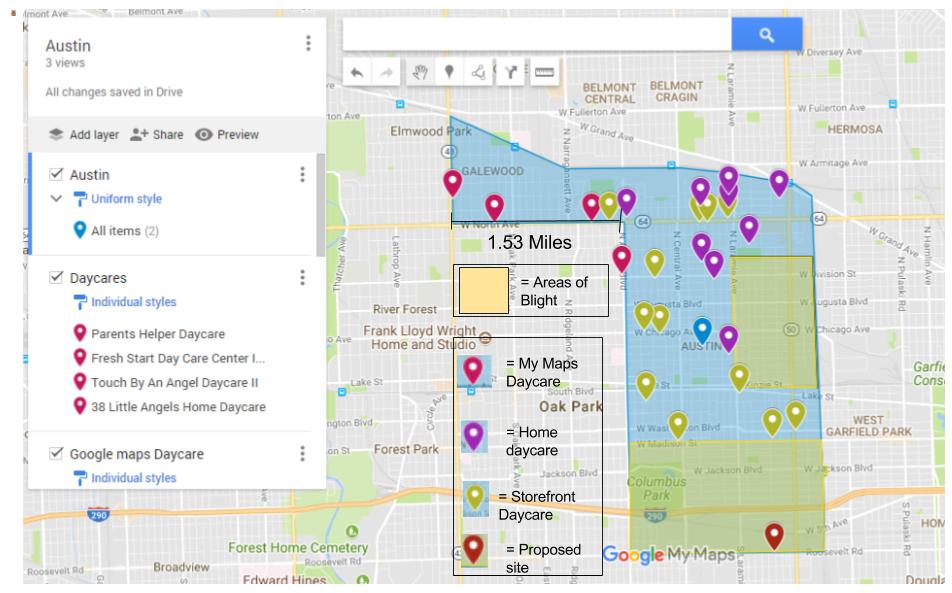
For this map, I chose to edit my last map. I took the image of my map and put it into Google drawings. I studied the map and found the areas of so-called “blight”. These were areas that were in my opinion in need of a daycare. I understand that it may be very easy for parents to drive or take their kids to another part of the neighborhood for daycare but I think that for the maps sake, there are definitely areas that could need more daycares. I do also realize that parents can take their kids to a different neighborhood for daycare as well, but for the purposes of the map, I will still consider these areas in need of more daycare. I used rectangles that I drew myself. These were the areas that had the least daycares near them. I noticed that the south side of Austin had no daycares that I can find south of Madison St. There is a large population of families that live on the south side of Austin that could take their kids to different neighborhoods nearby like North Lawndale or Cicero or even Garfield Park area. I still think that it could benefit the people of South Austin to have more daycares in the south side of Austin. I also added a key to make my map more distinguishable. I showed each color of the pins and what they mean. I also showed what the yellow highlights. I also decided to put in a line that shows the mileage. For this map, I chose to do more of a stark boundary map. these maps were used by Ernest Burgess who was a cartographer at the University of Chicago in the early 20th century. He is known for drawing the lines of Chicago's neighborhoods. These lines that we know so well came from him. I am taking this outline of Austin and using it to map my issue. I had thought about doing a dot map to show the daycares around Austin. I decided not to use this approach because the purpose of a dot map is to not show any boundaries. I wanted to show the distinct boundary of Austin to show how they daycares orient themselves inside of the boundary of Austin. Bill Rankin is a professor at Yale University. He created a dot map of Chicago. I really liked this map and thought about making something like this map, but I thought that showing the exact locations of the daycares and the stark borders of Austin were important for my map's agenda. I think it is important for these areas to receive daycares because of the statistics that we see in Austin today. More than 30% of Austin’s residents live below the poverty line. The most common income in the area is under $25,000 annually. 40.5% of Austin’s residents make less than $25,000 annually. Also, in Austin, the largest age cohort is people under the age of 19 with 29.1% of people belonging to this age group. This means there are many children in the community. Many people in Austin also live in poverty and have to work long hours and cannot provide care for their children all the time. Lots of people leave their children in daycare.
 |
| CM "Map 3" (2018) |
For this map I chose, like the last map, to edit my previous maps. I once again used Google Draw to edit the previous maps. I wanted to create a daycare that could house more kids than a regular storefront daycare. I did some research on Google maps and found a large industrial building with space for lease. The building is on Roosevelt road and is on the south side of Austin. This space has a warehouse component and retail. I think I could use some of both to create a large daycare. The space is right on the edge of Cicero and is by other neighborhoods that could also bring their kids there. This site is not very close to the kids on the east side of Austin, but there are daycares nearer to them there than there are for the kids in south Austin. This retail space is clean but the building is shared by other retailers including a furniture showroom and a digital imaging company. As long as the other companies in this space are not doing anything that is heavy manufacturing or things that could produce harmful chemicals, but I do not see any other companies that are doing that. I decided to put this area on the border of Austin because it is a less industrial area than some other places in South Austin. Roosevelt road has some office buildings and industrial buildings on the Austin Side, and residential on the Cicero side. I think this would be better for the kids so they are not in the middle of the industrial area and have residential streets and parks nearby for them to enjoy. The creation of this new large daycare will also produce a lot of jobs in the area. This is an area that had problems with unemployment and poverty. According to CMAP’s community data snapshots, 44.7 percent of people in Austin are not in the Labor Force. Out of the 55.3% of the people who are in the labor force, 19.5% of people are unemployed. I also took a look at 2nd City Zoning. This is a website that shows the land usage in Chicago. When I look at the neighborhood of Austin, I see a lot of different patterns. The green represents residential. The yellow represents industrial areas. The blue represents commercial use. Red is for planned development and institutional. I looked at this to see where my daycare would fall into. The yellow highlighted box is the general area where the daycare would be. This would be in an industrial area. I am not surprised by this. if you have ever driven through this area, you would know that it is very industrial. I am ok with this being a location for a daycare as long as there is not too much heavy manufacturing nearby. I scouted it out on Google Maps and did some research and didn't see anything that I would consider a threat to kids in the area.
 |
| CM "2nd City Zoning" (2018) |
In conclusion, the area of Austin is a well-developed community. Emily White Hodge is the director of operations at New Moms, which is a group that helps new moms with their babies. They help them find jobs and provide classes and care for their families. When I asked Emily what strengths she saw in the community, she said: “The strengths we find in our community include: community organizing & strong neighborhood involvement, strong connections - residents talk to each other & help one another, child development centers - there are many and they are connected services: financial, job-readiness, government etc.both neighborhood & magnet schools.” Austin is a large area and has some issues with poverty but they do have childcare. I think there is a possibility to make it more accessible. These plans and maps I have made show what areas are in need. I hope Austin continues to grow and keep developing.
Works Cited:
“Community Data Snapshots.” Www.CMAP.illinois.gov, www.cmap.illinois.gov/documents/10180/126764/Austin.pdf.
“CtaSystemMapBrouchure.pdf.” Www.transitchicago.com, www.transitchicago.com/assets/1/brochures/ctaSystemMapBrochure.pdf.
“Daycare Licensing in Chicago.” Www.cityofchicago.org, City of Chicago, https://www.cityofchicago.org/dam/city/depts/bacp/general/daycarefactsheetbacp102610.pdf.
Eltagouri, Marwa. “Austin Population Drops to No. 2 in City for 1st Time in 45 Years.”Chicagotribune.com, 15 July 2017, www.chicagotribune.com/news/local/breaking/ct-austin-population-decline-met-20170714-story.html.
Resident, Current, and Niche User. “Living in Austin.” Niche, 26 Jan. 2017, www.niche.com/places-to-live/n/austin-chicago-il/
Zoning, 2nd City. “2nd City Zoning.” 2nd City Zoning, DataMade, secondcityzoning.org/.