About Me

I am a student at GCE Lab School in Chicago. This is my blog to show all my work.

Pages

Thursday, February 15, 2018

Multiple Sclerosis: A Personal Perspective

In the second STEAM class of my sophomore year, we are learning about the body. This class is called Disease, the first unit is called Body. In this unit, we learned mostly science. We learned about cancer and how that affects the body. We also learned about each organ system and the organs included in them and what they do. I am a total surgical junkie, so I already knew all of the material in this unit, I did break off a little bit and did some extra research for myself. We also learned a math concept called completing the square. This is another way to solve quadratic equations. I have done a lot of work in quadratics in the past, but I have never learned this technique. It was actually really easy to learn and same a lot of sense. We did not take any FEs this unit, but I hope for some cool ones in the following units. For this action project, we were asked to conduct an interview. It had to be anonymous but we had to find someone with a disease and interview them about it. We then had to write up their profile and classify their disease in accordance with what we learned in class. We also had to draw a picture of each of the body systems that the disease affects. I made the outline of a human body and then used transparencies to draw the affected organ systems. I interviewed a woman in her late 40s with Multiple Sclerosis. I really liked this project, I was able to talk about the things I love to learn about. I really didn't have any issues with this project and I look forward to the rest of this class and the next class.

For this action project, I thought about who I could interview. I have some family members and some friends who have or have had diseases. I decided to interview someone with Multiple Sclerosis.

Multiple Sclerosis

Multiple sclerosis or MS is an autoimmune disorder of the central nervous system or CNS. The CNS is the body’s control system. An autoimmune disease is when the body’s immune system attacks a healthy system or organ in the body. In the case of MS, the body’s immune system is attacking the myelin, which is the protective sheath on the nerve fibers, brain, and spinal cord. The myelin is damaged and interrupts the signals from the brain and the nerves, eventually leaving the nerves damaged. MS patients may have a wide variety of signs and symptoms depending on which nerves and how many nerves are affected. It could be a very small localized area or large areas. MS can have drastic effects on life. The loss of motor function or blindness are some extreme symptoms of MS. Some less severe cases can be managed with medication with little or no symptoms in day-to-day life. The most common type of MS disease course is a relapsing-remitting course. This means that symptoms of the disease come and go. Symptoms will appear over time and then get better. These periods of quiet time can last weeks to years. According to the Mayo Clinic, 60-70% or relapsing-remitting MS have steady progression and no relief time: this is called secondary progressive MS. There is also a course where people have a gradual onset and steady symptoms, this is called primary-progressive MS.

Symptoms

Symptoms of MS can vary from person to person. The most common type of symptoms a patient will experience are:
  • Numbness and weakness in limbs
  • Partial or total vision loss and pain when moving eyes
  • Double vision
  • Headaches
  • Tingling in extremities
  • Tremors
  • Fatigue
  • Dizziness
  • Slurred speech.
  • Problems with bladder and bowel function.
Classification

This disease is a genetic disease. MS is a non-transmittable disease. The cause of this disease is still unknown. The only way the disease is linked to other people is genetically. If you have a sibling or parent who had had MS, you are at higher risk of contracting the disease. MS is not transmitted through the air or bodily fluids. Some risk factors for contracting MS include:
  • Family history - people with an immediate family member that has or had MS you are more at risk.
  • Viruses - certain kinds of viruses have been connected with MS like the Epstein Barr virus that causes infectious mononucleosis. 
  • Autoimmune diseases - diseases such as Type 1 diabetes, Thyroid disease, or Inflammatory Bowel Disease. Smoking also causes a higher risk of contracting MS. 
  • Age - people between the ages of 15 and 60 are the most at risk for MS
  • Gender - women are twice as likely of getting MS than men.
MS is most common in areas with temperate climates such as the northern US, Canada, south-eastern Australia, New Zealand, and Europe. The most common racial group to contract MS is people of Northern European descent. People who are of African, Asian, or Native-American descent have the lowest risk of contracting MS. There is no geo-economical link to MS at this point.

Nobody really knows why people contract MS but there are some risk factors like I stated before. The person I decided to interview is a 48-year-old female named Lynn. She has 2 teenage daughters and a husband. Lynn was diagnosed with MS 8 years ago in 2010. Lynn is a woman which means she was already at a higher risk. She also is of Northern European descent which it the most at risk racial group. She also lives and is from the northern United States which is one of the most at risk geographical locations. Lynn’s grandmother always had an undiagnosed neurological condition that could have been MS. Lynn also had Mononucleosis when she was in high school. This disease is caused by a bacteria that might be related to MS.

Lynn

It was the summer of 2010 and Lynn was living her life normally. She one day started to notice something funny with her vision. “It was weird,” she said. “Because for a couple days, I had been like feeling like something was weird with my vision. It was just, I couldn’t quite put my finger on what was going on, but it was like when I would turn my head quickly, my eyes weren't tracking right. We went to a dance recital and I really realized I was seeing double.” These are both very common symptoms of MS. Lynn also had a strange tingling feeling on her thigh. “It was like I had had a Novocaine shot.” she described. “ I did mention it to my doctor, and she said (“Well, I’m sure you don’t have MS.”)” It turns out the doctor was wrong. Lynn also experienced numbness and tingling on her extremities, another very common symptom. She was finally diagnosed later in the summer.

Lynn was diagnosed by the results of a series of tests. She underwent several MRIs which stands for Magnetic Resonance Imaging. These scanned her brain to look for lesions. She also underwent a Lumbar Puncture or Spinal Tap. This is a minor surgical procedure in which a large spinal needle is inserted between 2 lumbar vertebrae into the spinal canal to collect a sample of cerebrospinal fluid, this is the fluid that is on the outside of the spinal cord. The fluid is tested to rule out other neurological diseases such as meningitis.

Lynn’s treatment consisted mostly of medication and follow up imaging. MS is an incurable disease. Symptoms can be managed and pain can be relieved, but the disease is always going to be in the body. She was prescribed Copaxone which is a medication that blocks the immune system from attacking the brain or an Immunosuppressant. This medication must be taken daily and is administered by an injection beneath the skin. Lynn could give herself these injections at home. She would take this injection every night, she would rotate between her thigh, buttock, stomach, and arm.She recalled, “It was scary the first time I had to do it because I didn't know how it was going to feel. I was relieved that it was not as bad as I thought. I found that I had injection site reactions. Early on I had pancake sized welts that were red and itchy.” The side effects of this medication are bruising and skin irritation at the injection site.

When she was first diagnosed, Lynn was admitted to the hospital for a little over a week in the summer of 2010. This was because the intravenous steroids they were giving her called Solu Medrol needs constant blood testing and can damage the liver. “It was mostly annoying because I actually felt fine and didn’t feel like there was a reason I needed to be in the hospital. I was mostly worried about my kids because they were only 8 and 5.”

Today, Lynn lives life much like anyone else would. She has to take her Gilenya pill every night. She now takes this pill instead of the injection. Lynn’s symptoms are managed by the medication and she has no side effects in her day-to-day life. Lynn still has to go to frequent doctor’s appointments for MRI’s neuro exams and blood testing. These are all precautions to make sure she is prepared and aware if she has a relapse.


CM "Nervous System" (2018)

MS affects a few systems of the body. The main one is the Nervous system. The nervous system is bodies control system. The brain makes all of our decisions and our nerves make us move and feel pain. Our sensory organs pick up on external senses and turn that into information to our brain. The lymphatic system attacks the coating on the nerves and causes damage and can eventually destroy them. The coating on the nerves Myelin also coats the brain and spinal cord. This is the coating that deteriorates and leaves the nerves damaged.

CM. "Lymphatic System." (2018)

The Lymphatic System is the body’s defense system. It protects us from diseases. The Lymph nodes produce the chemical lymph that fight diseases. Sometimes the immune system attacks healthy parts of our bodies. This is called an Autoimmune disease. In a person with MS, the immune system attacks the healthy coating on the nerve fibers causing them to become damaged.

CM. "Digestive System." (2018)

The Digestive System is the body’s processing system. Food goes in and is processed and the waste comes out. The intestines absorb nutrients from the food and add water. They then empty the waste out the anus. In patients with MS, one symptom might be problems with bowel control. This means patents might have a hard time controlling when they defecate..

CM. "Renal System." (2018)

The Renal or Urinary System is the body’s liquid waste system. The kidneys filter the blood and absorb the nutrients. The waste from the filtered blood then goes down the Ureters into the Bladder, which is a holding place for the liquid waste. When the body has to urinate, the liquid is released into the urethra where it exits the body. Some patients with MS might have trouble with bladder function. This means patients may have a hard time controlling when they can urinate.

In conclusion, I really liked this project and didn't really have any trouble with it. The only problem was that I included too much information. I was over 400 words over the limit. I had to take out a lot of information that I thought was valuable, so I didn't like that much. Other than that, everything went smoothly and I am proud of how it came out.

Works Cited:

“Diagnosis.” (2017) Mayo Clinic. Mayo Foundation for Medical Education and Research. Web. 15, Feb, 2018.
https://www.mayoclinic.org/diseases-conditions/multiple-sclerosis/diagnosis-treatment/drc-20350274

Moody, C. (2018, February 11) Personal Interview.

“Multiple Sclerosis.” (2017) Mayo Clinic. Mayo Foundation for Medical Education and Research. Web. 9, Feb, 2018.
https://www.mayoclinic.org/diseases-conditions/multiple-sclerosis/symptoms-causes/syc-20350269

“What Causes MS?” (2018) National MS Society.org. National Multiple Sclerosis Society. Web. 9, Feb, 2018.
https://www.nationalmssociety.org/What-is-MS/What-Causes-MS

Sunday, January 21, 2018

A Map For The Children

For this winter elective term, I took a humanities class called Thin Red Lines. In this class, we dove really deep into issues in the community. I kind of thought this class would be a class where we learned about maps and the history of maps as well as geography. We really didn't do any of this in the class. I was somewhat disappointed, but this course really opened my eyes to issues in the communities that surround us. We talked a lot about Tax Increment Financing districts or TIF districts. Many people may have heard of these TIFs but not know what they are about. I had heard of them but I didn't really know anything about them. We also learned about mapping the community. We had a lot of field experiences in this course. We had some visits to our school including Tom Tressor who is the author of the book "Chicago Is Not Broke." He is a community activist and talked to us about TIFs. We also Skyped with Yale professor Bill Rankin who created a dot map of race in Chicago that we studied. We also went out to talk with Chicago Metropolitan Planning Council about how they map their programs and to Google where we learned about the app Waze. We only had one action project for this term. We completed tests in which we made maps of our neighborhood for different people and where we made out own TIF district. For this AP we were asked to make three transformational maps. We had to identify a problem and interview people. I thought this project was really challenging, and I actually had a really difficult time doing it.

Austin is a neighborhood sitting on the city’s far west side. It is the largest geographic neighborhood in Chicago. The neighborhood is known for its historical buildings and parks. The poverty rates in Austin are higher than many neighborhoods in Chicago with more than 30% of people in Austin living below the poverty line.

My project concerns the lack of early childhood development in the neighborhood of Austin. I am looking at the daycares in Austin and their quality. I show the existing daycares and map where there might need to be more.

The existing conditions in Austin include:

Demographics and Housing

Austin is a large neighborhood sitting on the Chicago's far west side. The following data is from 2015. The population is 97,643 people. There are about 32,037 households in the neighborhood. The racial makeup is mostly African American, with 81,066 people, which is 83%. The second biggest demographic is Latino, which has a population of 11,132, which is 11.4%. The third is white, with a population of 4,353, which is 4.5%. The largest age cohort is under 19. The most common household income in a year is less than $25,000, with about 40% of the population earning this much every year. The most common type of housing in Austin is a 2-unit building with 11,234 homes of this type in the area, about 30%.

Land Use and Development
Austin consists of 7.16 square miles of land. Out of all of this, the most common land use is for transportation and other. This uses 1,470.4 acres out of the total 4,574.2 acres or 32.1% of Austin’s land. The second most frequent use of land in Austin is single-family residential with 958.1 acres or 20.9% of land devoted to single-family residential. The third most common use of land is multi-family residential with 17.4% of the land used for this purpose. The majority of home types in Austin are 2 unit apartments with 30.2% of houses being 2 units. The most common house size contains 2 bedrooms with 37% of houses having 2 bedrooms.

Economic Development & Market Analysis
More than 30% of Austin’s residents live below the poverty line. The most common income in the area is under $25,000 annually. 40.5% of Austin’s residents make less than $25,000 annually. 85.9% of houses are occupied in Austin leaving 14.9% of homes vacant. A majority of people rent their homes. 60.5% of homes are renter-occupied and 39.5% of homes are owner-occupied. Most of the homes in Austin were built before 1940 with 24,880 or 66.7% of homes built before then. The next most populous time period is from 1940 to 1969 with 8,659 or 23.2% of homes being built in this time.

Mobility

Mobility in Austin includes two L lines and many bus lines. The two L lines that come in from the loop in Chicago are the Blue Line and the Green line. The Green Line runs on above Lake Street coming in from downtown. The Blue Line follows Interstate 290 or the Eisenhower in from the loop as well. Both the Green and Blue lines make some of their last stops in Austin. The Green Line's last stop is Harlem and goes through the loop and to 63rd and Cottage Grove on the South Side. The Blue line’s last stop is Forest Park and goes into the city and to O’Hare Airport on the city’s northwest side. Bus routes include the #66 Chicago Ave, #72 North Ave, #20 Madison Ave, #54 Cicero Ave, #57 Laramie Ave, #70 Division, #85 Central Ave, #91 Austin Ave, and  #126 Jackson Ave.

The Issue

In Austin, the largest age cohort is people under the age of 19 with 29.1% of people belonging to this age group. This means there are many children in the community. Many people in Austin also live in poverty and have to work long hours and cannot provide care for their children all the time. Lots of people leave their children in daycare. I wanted to see how many daycares in Austin are up to code and recognized by the city.

According to the City of Chicago’s daycare requirements and licensing pdf, daycares are licensed by the City of Chicago. The Department of Child and Family services also has to license any daycare that is in Chicago. Before the DCFS licenses a daycare, the city of Chicago must license it first. Home daycares only have to have a DCFS license and do not have to have a city license to operate.

The following is required to have a licensed daycare. This list is taken from the city’s pdf:

  • "Corporate documents such as Articles of Incorporation and Corporate Minutes 
  • Lease or proof of ownership of the business property
  • Name, resident address, social security number, date of birth, and official photo ID for every owner, officer, member, or any person having 25% or more interest in the business, and the manager of the establishment
  • Federal Employer Identification Number (FEIN). Apply at www.irs.gov
  • State of Illinois Business Tax Number (IBT). Apply at www.revenue.state.il.us. 
  • A criminal background check for every owner, corporate officer or any person having 25% or more interest in the business
The business activity must be reviewed and approved by the Department of Zoning. Your application will automatically be sent to zoning for a review.

Any City debt must be resolved prior to the issuance or renewal of any business license.

Once an application is filed, businesses must pass an onsite inspection from The Department of Public Health, Department of Buildings, and the Fire Prevention Bureau."

There are some daycares that are not required to have a license issued by the City of Chicago. These include: This list comes from the City of Chicago's pdf

  • "Home Day Care Centers - Child care provided in a private residential home receiving more than 3 and up to a maximum of 16 children for less than 24 hours per day do not require a City of Chicago Day Care License. However, a State of Illinois License is required to operate a home daycare for 3 or more children receiving care in a family home. 
  • Regularly constituted authorities of the United States, the State, the County, or the City conducting or operating a daycare center do not require a City of Chicago Day Care License. The State of Illinois may have different requirements. 
  • Programs serving children 3 years or older, established in connection with grade schools supervised or operated by a private or public board of education, or approved by the State Board of Education and after-school programs serving children over the age of 6 do not require a City of Chicago Day Care License."
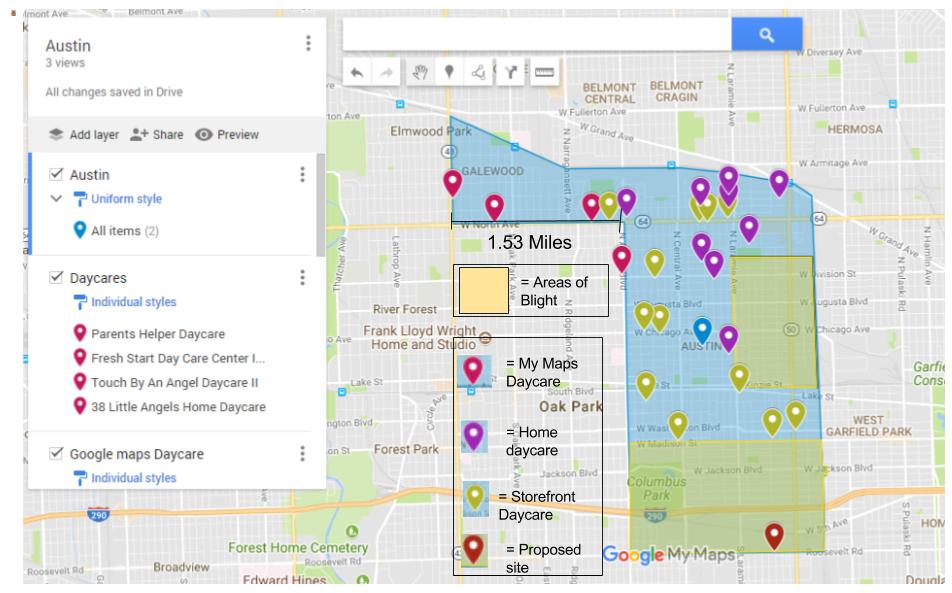
The following map is my existing conditions map. It shows current daycares in the neighborhood of Austin.

CM "Map 1" (2018)
In this map, I chose to use the Google “Create Maps” feature. I traced the outline of Austin myself. There is some question as to whether the northwest side of Austin, normally referred to as Galewood, is technically part of Austin. According to the Community Data Snapshots made by CMAP, the data from Austin comes from the Galewood area as well, making it technically part of Austin. I chose to draw my lines around Galewood too because all of my datasets include Galewood. I started off by Googling the outline of Austin. I paid attention to the fine details of each line and drew the outline myself. I decided to compare the four options when I searched daycare in the create a maps set. I then searched daycare in the regular Google Maps setting. I then sorted those into store-front daycares and in-home daycares. I used red to mark the original four locations. I used green to mark the storefront locations, and I used purple to mark the in-home daycares. I did all of this to see if I could see the difference in licensed daycares. I thought that maybe the four daycares had a higher form of license than the others did. From what I found on doing research and going on their websites, they don’t seem to have a higher accreditation than the other daycares I mapped. I chose to separate the home daycares from the storefront daycares because I thought home daycares might have a less rigorous screening system than storefront daycares. Most of the home daycares do not have their own websites. They seem to only have Facebook pages or Yelp pages with little or no activity or reviews. A lot of the storefront daycares have their own website with most of them looking professional. This makes me wonder if each daycare gets an equal amount of inspections and are up to code by the city. I know that home daycares do not have the be licensed by the city if they fit under certain criteria. According to the city of Chicago’s website: “Home Day Care Centers - Child care provided in a private residential home receiving more than 3 and up to a maximum of 16 children for less than 24 hours per day do not require a City of Chicago Day Care License. However, a State of Illinois License is required to operate a home daycare for 3 or more children receiving care in a family home”. Home daycares still have to be inspected and licensed by the state of Illinois.


CM "Map 2" (2018)
For this map, I chose to edit my last map. I took the image of my map and put it into Google drawings. I studied the map and found the areas of so-called “blight”. These were areas that were in my opinion in need of a daycare. I understand that it may be very easy for parents to drive or take their kids to another part of the neighborhood for daycare but I think that for the maps sake, there are definitely areas that could need more daycares. I do also realize that parents can take their kids to a different neighborhood for daycare as well, but for the purposes of the map, I will still consider these areas in need of more daycare. I used rectangles that I drew myself. These were the areas that had the least daycares near them. I noticed that the south side of Austin had no daycares that I can find south of Madison St. There is a large population of families that live on the south side of Austin that could take their kids to different neighborhoods nearby like North Lawndale or Cicero or even Garfield Park area. I still think that it could benefit the people of South Austin to have more daycares in the south side of Austin. I also added a key to make my map more distinguishable. I showed each color of the pins and what they mean. I also showed what the yellow highlights. I also decided to put in a line that shows the mileage. For this map, I chose to do more of a stark boundary map. these maps were used by Ernest Burgess who was a cartographer at the University of Chicago in the early 20th century. He is known for drawing the lines of Chicago's neighborhoods. These lines that we know so well came from him. I am taking this outline of Austin and using it to map my issue. I had thought about doing a dot map to show the daycares around Austin. I decided not to use this approach because the purpose of a dot map is to not show any boundaries. I wanted to show the distinct boundary of Austin to show how they daycares orient themselves inside of the boundary of Austin. Bill Rankin is a professor at Yale University. He created a dot map of Chicago. I really liked this map and thought about making something like this map, but I thought that showing the exact locations of the daycares and the stark borders of Austin were important for my map's agenda. I think it is important for these areas to receive daycares because of the statistics that we see in Austin today. More than 30% of Austin’s residents live below the poverty line. The most common income in the area is under $25,000 annually. 40.5% of Austin’s residents make less than $25,000 annually. Also, in Austin, the largest age cohort is people under the age of 19 with 29.1% of people belonging to this age group. This means there are many children in the community. Many people in Austin also live in poverty and have to work long hours and cannot provide care for their children all the time. Lots of people leave their children in daycare.

CM "Map 3" (2018)
For this map I chose, like the last map, to edit my previous maps. I once again used Google Draw to edit the previous maps. I wanted to create a daycare that could house more kids than a regular storefront daycare. I did some research on Google maps and found a large industrial building with space for lease. The building is on Roosevelt road and is on the south side of Austin. This space has a warehouse component and retail. I think I could use some of both to create a large daycare. The space is right on the edge of Cicero and is by other neighborhoods that could also bring their kids there. This site is not very close to the kids on the east side of Austin, but there are daycares nearer to them there than there are for the kids in south Austin. This retail space is clean but the building is shared by other retailers including a furniture showroom and a digital imaging company. As long as the other companies in this space are not doing anything that is heavy manufacturing or things that could produce harmful chemicals, but I do not see any other companies that are doing that. I decided to put this area on the border of Austin because it is a less industrial area than some other places in South Austin. Roosevelt road has some office buildings and industrial buildings on the Austin Side, and residential on the Cicero side. I think this would be better for the kids so they are not in the middle of the industrial area and have residential streets and parks nearby for them to enjoy. The creation of this new large daycare will also produce a lot of jobs in the area. This is an area that had problems with unemployment and poverty. According to CMAP’s community data snapshots, 44.7 percent of people in Austin are not in the Labor Force. Out of the 55.3% of the people who are in the labor force, 19.5% of people are unemployed. I also took a look at 2nd City Zoning. This is a website that shows the land usage in Chicago. When I look at the neighborhood of Austin, I see a lot of different patterns. The green represents residential. The yellow represents industrial areas. The blue represents commercial use. Red is for planned development and institutional. I looked at this to see where my daycare would fall into. The yellow highlighted box is the general area where the daycare would be. This would be in an industrial area. I am not surprised by this. if you have ever driven through this area, you would know that it is very industrial. I am ok with this being a location for a daycare as long as there is not too much heavy manufacturing nearby. I scouted it out on Google Maps and did some research and didn't see anything that I would consider a threat to kids in the area.

CM "2nd City Zoning" (2018)

In conclusion, the area of Austin is a well-developed community.  Emily White Hodge is the director of operations at New Moms, which is a group that helps new moms with their babies. They help them find jobs and provide classes and care for their families. When I asked Emily what strengths she saw in the community, she said: “The strengths we find in our community include: community organizing & strong neighborhood involvement, strong connections - residents talk to each other & help one another, child development centers - there are many and they are connected services: financial, job-readiness, government etc.both neighborhood & magnet schools.” Austin is a large area and has some issues with poverty but they do have childcare. I think there is a possibility to make it more accessible. These plans and maps I have made show what areas are in need. I hope Austin continues to grow and keep developing.


Works Cited:

“Community Data Snapshots.” Www.CMAP.illinois.gov, www.cmap.illinois.gov/documents/10180/126764/Austin.pdf.

“CtaSystemMapBrouchure.pdf.” Www.transitchicago.com, www.transitchicago.com/assets/1/brochures/ctaSystemMapBrochure.pdf.

“Daycare Licensing in Chicago.” Www.cityofchicago.org, City of Chicago, https://www.cityofchicago.org/dam/city/depts/bacp/general/daycarefactsheetbacp102610.pdf.

Eltagouri, Marwa. “Austin Population Drops to No. 2 in City for 1st Time in 45 Years.”Chicagotribune.com, 15 July 2017, www.chicagotribune.com/news/local/breaking/ct-austin-population-decline-met-20170714-story.html.

Resident, Current, and Niche User. “Living in Austin.” Niche, 26 Jan. 2017, www.niche.com/places-to-live/n/austin-chicago-il/

Zoning, 2nd City. “2nd City Zoning.” 2nd City Zoning, DataMade, secondcityzoning.org/.

Thursday, January 18, 2018

Carpentry 101

I have always had an interest in woodworking. I think it is a cool art form and is very practical. That doesn't mean I'm good at it. I have taken this course with the same teacher in my Freshman year and I really enjoyed it. We made a cornhole set, a bench, and many other things. I wasn't able to take woodshop for fall term but I was able to for the elective term. I really enjoyed the course this term. I struggled a little bit with things, just because I am not very good at carpentry, but I got the hang of it.

We started out by planning what we wanted to do. I honestly don't remember why I chose to make a box. I was not the only one who made a box in the class so I would assume the idea was suggested by our teacher. We then learned how to use all the tools. We practiced with the table saw, the chop saw and the nail gun.

CM. "Box Sketch." (2018)

Once we were certified to use the machines we started making out designs. I started off by marking the pieces of wood with the correct measurements. I chose to do a square box that would by 5in x 5in. We cut the pieces out of wood with the table saw. Once all the sides of the box were cut we had to add grooves to the top of the sides of the box so the top could slide in and out. We did this by setting the blade of the saw down really low so it doesn't;t cut all the way through the piece of wood. Our teacher warned us that the saw could kick back and could send the wood flying, but he said that rarely happens. But as luck might have it, while my teacher an I were cutting my piece of wood, the saw kicked back grazed my arm, and flew with such force back into the window shattering it. That was a fun experience.

After that, we were not allowed to use the saw anymore. Our teacher cut the rest of the pieces out without incident. Once we had all the pieces it was time to nail them together. I used a clamp the put the 2 pieces together. I then had to use the nail gun to stick them together. I was not very fond of the nail gun as I thought I would accidentally shoot myself. Once we had it all nailed together, I took some small nails and a hammer and secured the base on. Some of my nails didn't go into the wood so I had to start over.

I then made a mixture of sawdust and glue and rubbed it in al the seams of the box. This was to seal it and smooth it out. This mixture was very gross feeling and dried way to fast. After that had dried I had to spend a long time sanding all the glue mixture down so the surface was smooth. That was very time-consuming. I then stained the piece and it was finished!

CM (2018) "Box."

CM (2018) "Box."

CM (2018) "Box."

In the end, I am glad I took this workshop. I learned a lot about woodworking and a good lesson on safety. I had some struggles with nails and the pieces not fitting correctly, but I worked through all of these problems and now have a little wooden box I have no idea what to do with. Now I definitely know orthopedic surgery isn't for me.

Printing in 3D for GCE

In my elective class Rapid Prototyping, we are finishing up our 3rd and final unit. In this unit called "3D" we learned about everything 3D. We learned the differences between Cartesian and Delta 3D printers, and we learned about functions and Riemann sums. We took a field experience to the Museum of Science and Industry. At the museum we looked at the Fast Forward exhibit which shows innovations that scientests have made. We also saw the Toy Maker 3000 which is basically a mini factory. The last one we saw was Robot Revolution where we saw all sorts of different robots and  how they work. For this action project we were asked to partner up. I was hesitant at first because I like to do perfect work, but I got a good partner and we only had to design the object togther. We had to make the object useful around the school. We also made the object out of clay and cardboard which was messy and difficult. I didn't really have any trouble with the 3D printer but the cardboard model was very painful and took a long time. I pulled through and I ended up with a nonfunctional cardboard model. You can make your own marker holder by clicking here! Our design was remixed from Thingiverse user kielerr. You can check out their original design here. This action project was done with partners so you can check out my partner GGS's blog here.


In the end, I liked this project. It was essentially the same project 3 different times, but they were all pretty easy projects and I liked how each one came out. My favorite part of this poject was learning how to use the 3D printer and designing a object to make.

Wednesday, December 13, 2017

Carve Your Heart Out

For our 2nd unit in my STEAM class Rapid Prototyping, we learned about 2.5 dimensions. Building off our lass unit, we went from measuring distance in 2D to measuring distance in 3D. We also learned about density, volume, and mass. We learned how to calculate all of these, and about the units they measure. We learned about conversions to the metric system because that is important in measuring density. We also discussed the differences between accuracy and precision. We took different scenarios and decided if they were accurate or precise, both or neither. We took an FE to the Harold Washington Library. We visited YouMedia's teen space. YouMedia is an organization to educate teens and provide free services for teens to be creative. They have a space in the library with recording equipment, art space, and 3D printers and vinyl cutters. We also visited their maker lab with many 3D printers, vinyl cutters, Carveys, and laser cutters. For this action project, we were asked to create 2 mini plaques showing GCE's 5 core values: AAPGA. Accountability, Autonomy, Purpose, Gratitude, and Achievement. I chose autonomy because I like the aspect of self-awareness in a small community. We were e given a lightweight material called Foamular. We created a design on the Easel software and used the Carvey to carve the design. We then had to try to recreate the design by hand. We then had to take measurements and do calculations and compare and contrast the experiences.


Overall, I liked this project a lot. I enjoyed using the different tools that I haven't gotten to use very much. I had some challenges with the handmade sizing, but I just kept trying, and I got it to work using stencils and rulers. I am most proud of how the handmade plaque came out. I didn't expect for it to come out as cleanly as it did.

Make sure to click here for a heart being carved out. 

Thursday, November 30, 2017

Cut it Out

In my class Rapid Prototyping, we learned all about machines and calculations. In the first unit, we learned about CNC machines. CNC stands for Computer Numerical Control. These are machines that use numbers to cut out intricate designs. We have a few of those in our classroom called Cameo Cutters. These are machines that cut out designs in different materials such as paper, fabric, and vinyl. We also did a lot of review math (review for me, I thought it was very easy). We learned some basic geometry and shapes of quadrilaterals and triangles. We also did some review of graphing and lines on the coordinate plane. We took an FE to mHub, which is a maker studio in Chicago. We got a tour of the facility and talked to various workers and companies that had offices in the facility. We learned about the many machines they had, including CNC machines. We also talked to the founder about his inspirations in the field of engineering. For this project, we were asked to choose an SDG and make 2 mini posters with a title, number, and design. We made one by hand, and one with the Cameo Cutters. We were then asked to graph the design and calculate distances. We also had to compare the 2 experiences together to figure out which method we preferred.


I thought that this project was decently challenging despite its simple sounding directions. I didn't really struggle with this project, and I enjoyed the challenge of working with computers, which I am not very comfortable with. I enjoyed seeing the finished project as always, and I somewhat look forward to the rest of what this class had to offer.

Sunday, October 29, 2017

The Stuff of Wonders


For our final action project for our STEAM class Populations, we didn't have very much time. We spent a lot of time in unit 2 and we learned a lot of valuable things. You can view my action project for unit 2 here. For unit 3, we only had about two weeks. Because of this, our teacher decided to not put a full action project on us. This was because our teacher wanted to make sure we understood what we were studying. Consider this project a mini action project. For this unit, we learned about preservation methods and population changes. We looked at data from all around the world about population growth and carrying capacity. We asked the question: “Why is it important to tell the story of populations for future generations.” When we asked this question we started learning about preservation methods. We took a trip to the Peggy Notebaert Nature Museum in Chicago. There, we looked at different organisms and a lot of taxidermies. We also saw a demonstration of a bird going through the taxidermy process. For this final project, we were asked to pick a method of preservation, I chose taxidermy. With this method, we had to create something to explain why it is important I chose to do a short essay.

What is taxidermy? Many people might know what it is and think it is pretty gross. I would like to offer the point of view that it is a beautiful form of art and science combined. Taxidermy is when an animal dies and its skin is collected to turn it into what it would look like when they were alive. The process of taxidermy can be small scale or very large scale. No matter the animal, the process is the same. You take the skin of the animal and stuff it with a moisture absorbing material. You then sew the animal back up and pose it into what it would look like in real life. This kind of process is called a display mount. This is for viewing purposes and is usually not meant to be handled. The process may sound simple, but it can be very time consuming.

This is an example of what taxidermy looks like. It can look very realistic. Taxidermy can be a form of art. Some taxidermists are better than others, just like artists. Some taxidermied animals are put in dioramas to make it look like they are in their natural environment. This bald eagle is not placed in a diorama. He is in a case with other birds and placed on a fake rock.

DS. Bald Eagle, (2017)

Taxidermy has been around for a very long time, thousands of years in fact. Taxidermy goes back to Ancient Egypt when people would mummify their pets. Taxidermy has gone through many innovations. In the middle ages, people got a lot better at taxidermy. A man named Pierre Belon was the first person to publish a book on taxidermy. He published his book in 1555. In the Victorian era, taxidermy was at the peak of its popularity. People would go on trips and kill and taxidermy animals to document their travels. This is when taxidermists started putting forms in the skins instead of stuffing. This made the animal look more realistic. This is also when people started placing taxidermied animals in natural positions and in dioramas. 

CM. Deer. (2017)

This deer is placed in a diorama. You can see the background and the plants surrounding him. There are also other animals in the scene to make it feel like it is a forest. Dioramas are an important part of taxidermy, and often they will go together. A diorama shows what the animal’s natural habitat would look like. This can provide more context to a specific animal. There may even be other animals that are not of the same species but do live together in the wild included in the diorama.

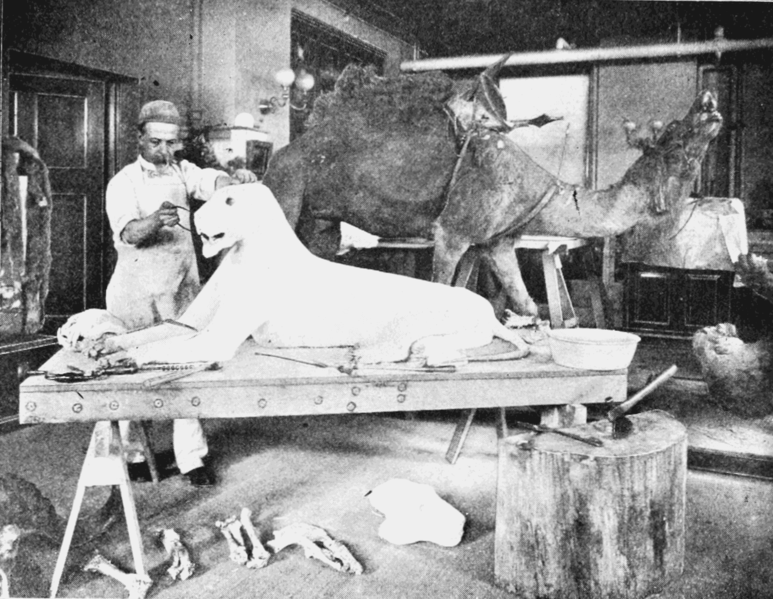
Unknown. PSM V59 D023 The taxidermy laboratory.png. (1901) Wikimedia Commons.

This is what a taxidermy laboratory looked like in the Victorian era.

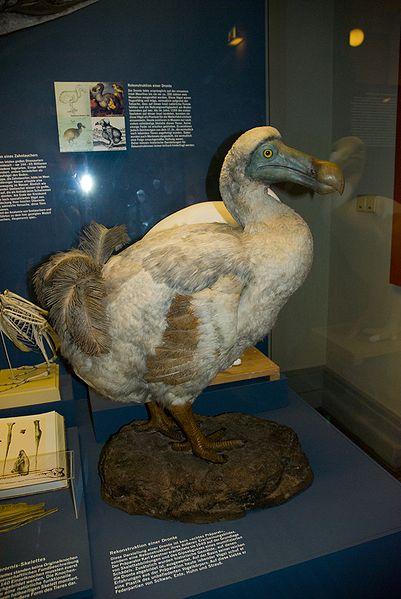
Taxidermy can also be used to create animals that are extinct. Taxidermists take various skins and parts from other animals and make it look like an animal that has gone extinct hundreds of years ago. This is how it works in the case of the Dodo Bird. These birds were hunted to extinction hundreds of years ago. We have no bodies left, but there are taxidermied statues of them made out of different animals


Thomas Quine. Raphus cucullatus -Museum fur Naturkunde, Berlin, Germany -taxidermy-29Aug2009.jpg. (2009) Wikimedia Commons

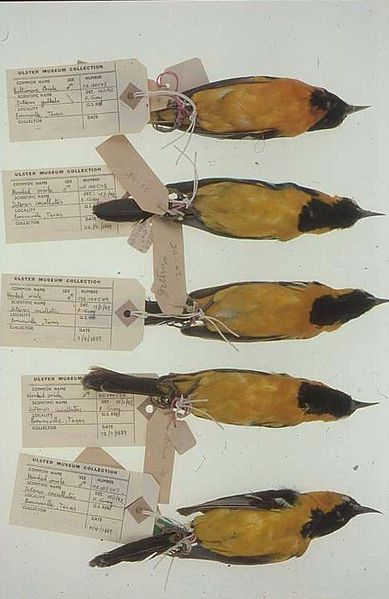
Taxidermy is very important for scientists and citizens. There is a special kind of taxidermy called study skins. This is used not for display but for research. The animals are usually tucked and put in drawers. These specimens can be very old. Scientists can go back and look at the animal's years later and make measurements and observations as to what those animals looked like when they died. These study skins are very important because it allows scientists to look into the past. These study skins can provide answers as to what different animals looked like in different time periods. They can also compare shape, size, colorations, and markings on the animals to animals today.


Notafly. BNHSColl.jpg. (2007) Wikimedia Commons.

 Citizens can benefit from taxidermy as well. Taxidermy can educate people. Schools often take field trips to museums with taxidermy displays.Taxidermy teaches people about animals from all around the world and in all shapes and sizes. Additionally, people can also learn about extinct and prehistoric animals.

Sources Cited:

The Taxidermist. “How Taxidermy Got Its Start.” The Taxidermy Hobbyist. N.p. N.d. 29, Oct 2017.
http://taxidermyhobbyist.com/history-of-taxidermy/how-taxidermy-got-its-start.html

In the end, I liked this project and this class. I thought we maybe could have done a full action project, but I enjoyed doing something different. I thought the most challenging part of this project was writing it. I didn't find that hard though. This project was a nice and fun way of ending this class. I really enjoyed the class population, and I am glad that I did well the whole way through.

Marine Biodiversity Literature Review

It's officially my last action project at GCE! I've done over 80 action projects and here is my last. This project is for my last Se...